
Opening Snapshot
It’s been a month of carnage.
The US and Israel escalated their confrontation with Iran into open kinetic conflict. Bombs, assassinations, and missile strikes that pierced Israel’s Iron Dome. Iran struck back at neighbouring countries and US military targets in the region.
Oil exploded. WTI crude ripped from $67 to $101 — a 51% move in a single month. That kind of move in energy doesn’t just affect petrol prices. It rewrites the inflation outlook, forces central banks to rethink, and sends shockwaves through every asset class on the planet.
Gold and silver, which had been the darlings of the last several months, got smashed in a violent liquidation. Gold dropped nearly 11% and silver cratered 19%. When you see precious metals sell off that hard during a geopolitical crisis, it tells you one thing — margin calls. Investors were forced to sell what they could, not what they wanted to.
This was a classic risk-off month with a very specific catalyst.
Australian Market
The ASX 200 opened March at 9,199 and closed at 8,482. That’s a 7.8% decline, wiping out all of February’s gains and then some.
The intraday low of 8,262 was the real moment of truth. That’s a 10% peak-to-trough drawdown from the February highs above 9,200. Technically, a correction.
But here’s what matters. The market found buyers in the 8,200s and bounced. As we noted early in the piece, the support zone between roughly 8,200 and 8,500 has been a reliable area of demand since mid-2025.
It held again.
The recovery from the lows was not euphoric. It was measured and cautious.
That’s actually what you want to see. Panic bottoms that rip 5% in a day tend to get retested. Grinding recoveries that build a base tend to stick.
We’re not out of the woods. But there’s a recent low to anchor to and the buyers have shown appetite.
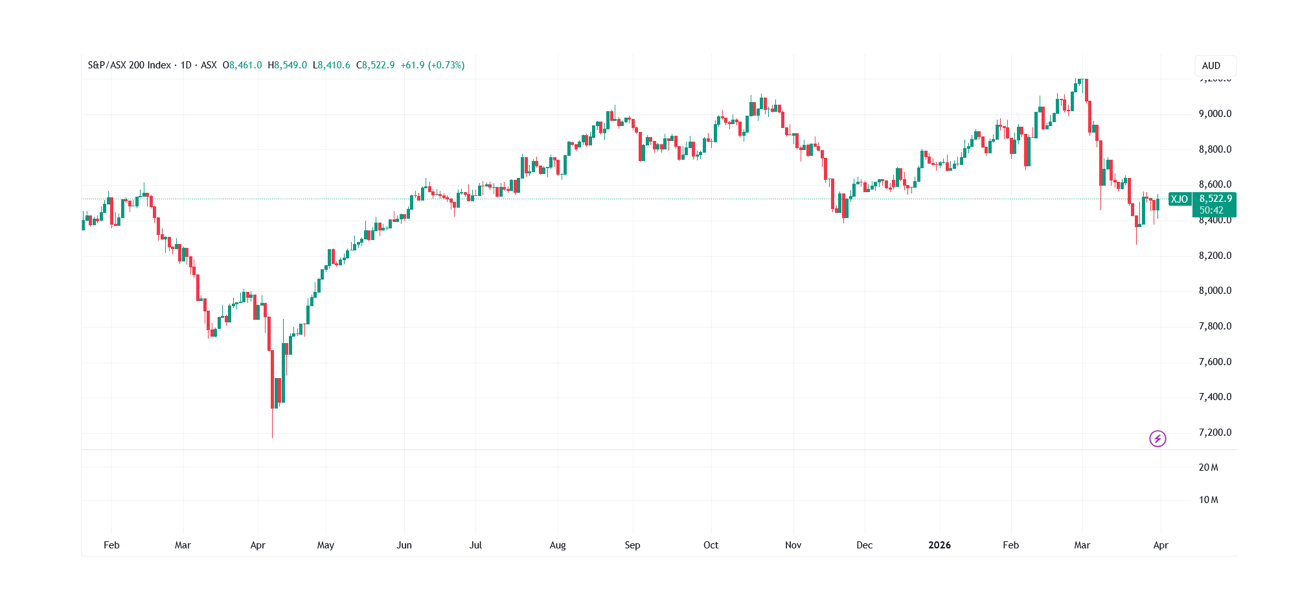
The ASX S&P200 index (Source: TradingView)
Inflation and Interest Rates
The oil shock has thrown a grenade into the inflation debate.
Before March, the market was slowly coming to terms with a couple more RBA hikes this year. Inflation was sticky but manageable. The RBA was hawkish but not panicking.
Now?
A 51% surge in oil prices feeds directly into transport costs, food prices, and energy bills. That’s not core inflation, it’s headline inflation, but the RBA can’t ignore it and neither can households.
The US 10-year yield pushed from 3.96% to 4.31%, a meaningful move that reflects the market repricing inflation expectations higher. The bond market is telling you that the ‘higher for longer’ narrative just got extended.
The Australian dollar weakened to 0.6846 against the greenback, down 3.6%. A weaker dollar makes imports more expensive, which adds another layer of inflationary pressure at exactly the wrong time.
If oil stays above $100, the RBA has a serious problem. They can’t cut into an oil shock. They may not even be able to hold. The risk of additional hikes just went up materially.
Sector Themes
Energy
Energy was the undisputed winner. The sector surged 13.5%, the only green on the board.
Woodside Energy (ASX:WDS) ripped 23.8% to $35.05. Santos (ASX:STO) climbed 17.8% to $7.96. When oil goes from $67 to $101. It’s that simple.
The question is sustainability. If the Iran situation escalates further, oil stays elevated and energy keeps running. If diplomacy takes over, oil unwinds and so do the energy names. For now, the trade is working and the earnings tailwind is strong.
Materials
Materials got destroyed. The sector fell 15%, the worst performer by a wide margin.
BHP (ASX:BHP) dropped 13.7% to $50.39. Copper fell 6.9%. The narrative that had been supporting the big miners — electrification, supply constraints, China stimulus — got overwhelmed by the risk-off trade.
Fortescue (ASX:FMG) held up relatively well, finishing down 3.9% at $20.31. Iron ore rose 7.4%, and FMG’s cost discipline continues to insulate it from broader sector weakness.
Northern Star (ASX:NST) collapsed 32.8% to $20.36 and Evolution Mining (ASX:EVN) dropped 23.9% to $12.62. This despite gold itself only falling 11%. When the miners fall harder than the metal, it’s forced selling and margin calls, not a fundamental reassessment. Watch for a snap-back.
Technology
Tech fell 13.2%, continuing the pattern we’ve seen for months. Higher yields compress multiples, and tech wears it first.
WiseTech Global (ASX:WTC) dropped 20% to $38.02. Xero (ASX:XRO) fell 9.7% to $75.12. Appen (ASX:APX) lost 24.1%.
This is getting overdone. At some point, the valuation compression creates opportunity. But that point requires yields to stabilise, and yields won’t stabilise until the oil shock is priced through. So tech investors need patience.
Consumer Staples
The relative safe haven. Consumer Staples fell just 1.1%, dramatically outperforming the broader market.
Woolworths (ASX:WOW) was actually up 1.1% to $36.41. When everything else is getting sold, people still buy groceries. That defensive quality is exactly why WOW trades where it does.
Financials
Banks fell 5.7%, less than the index.CBA (ASX:CBA) held relatively well, down 4% to $167.70.
NAB (ASX:NAB) was hit harder, down 15.5%. The smaller banks are more exposed to credit risk repricing, and the market is starting to differentiate.
Standout Stocks and Stories
Telix Pharmaceuticals (ASX:TLX)
The standout performer of the month. Up 36.6% to $13.66 in a market that was falling apart around it.
This is what happens when a company delivers on its pipeline while the market throws a tantrum. Telix’s radiopharma thesis remains intact, and the revenue trajectory is starting to show the acceleration investors have been waiting for.
Woodside Energy (ASX:WDS)
Up 23.8% to $35.05. Pure oil beta. When WTI goes from $67 to $101, Woodside’s earnings estimates get revised upward in real time. The stock responded accordingly.
The risk is that this is entirely geopolitically driven. If tensions de-escalate, oil unwinds, and WDS gives it all back. But for now, the cashflow is enormous and the dividend is well supported.
Northern Star (ASX:NST)
Down 32.8% to $20.36. This is the kind of move that makes you sit up. A 32.8% decline in a month for one of Australia’s premier gold producers, while gold itself only fell 11%, is extreme.
This is forced liquidation. Gold miners were crowded trades after months of precious metals strength. When the margin calls came, the leveraged holders got wiped. The underlying business hasn’t changed. Gold at $4,648 is still extraordinarily profitable for NST. This looks like an opportunity for those with the stomach for volatility.
James Hardie (ASX:JHX)
Down 23.7% to $26.10. JHX is a US housing play, and US housing just got hit with higher yields, higher oil, and geopolitical uncertainty all at once. The sell-off is reflecting genuine macro headwinds for the US construction cycle.
Portfolio Spotlight
This is a tough tape for small caps. Our portfolio names weren’t immune to the broader sell-off, but the thesis on each remains firmly intact.
Lumos Diagnostics (ASX:LDX)
LDX pulled back 20% to $0.220 during the month. In a market throwing out anything without near-term cashflow, that’s not surprising. But the business has advanced with receipt of CLIA waiver approval now in place. That means immediate milestone payments. It also paves the way for a much bigger target market. We remain convicted on this one. As we noted in our latest update, the opportunity here is being mispriced by a market that doesn’t understand the sector.
Audeara (ASX:AUA)
AUA gave back 18.8% to $0.059. Again, small cap selling pressure, not a fundamental crack. Audeara hit operating cashflow positive recently — just — on the back of an R&D tax refund, but the direction of travel is clear. Revenue is growing, Japan and China distribution deals are progressing, and NMPA certification for the China hearing aid launch has been secured. Check out our latest update for the full picture. This is a name where patience will be rewarded.
Stakk (ASX:SKK)
SKK was down 15% to $0.017. At these levels the market cap is tiny and liquidity is thin, which means price action is noisy. The company specialisation and AI integration thesis we flagged in our 2026 outlook hasn’t changed. The company continues to bag big contracts and 2026 is setting up to be the year of SKK. This is a name to accumulate quietly and hold with conviction.
April Outlook for the ASX – Key Themes and Risks
The Iran situation is everything right now. Markets will trade on headlines until there’s either a ceasefire or a further escalation. Expect volatility to remain elevated.
Oil is the transmission mechanism. If WTI holds above $100, the inflation outlook for Australia and globally gets materially worse. The RBA meets in April and will need to acknowledge the changed energy landscape, even if they don’t act immediately.
Watch the gold miners for a recovery trade. The sell-off was technical, not fundamental. If gold stabilises anywhere near current levels, the miners are deeply undervalued relative to the metal price.
Earnings season wrap-up and forward guidance will matter. Companies that can demonstrate pricing power in an environment of rising input costs will be rewarded. Those that can’t will be punished.
The bull case requires de-escalation in the Middle East, oil pulling back below $90, and the RBA signalling patience. That’s a lot of things that need to go right.
The bear case is straightforward. Escalation continues, oil pushes higher, inflation expectations become unanchored, and the RBA is forced into emergency hikes. That scenario takes the ASX well below 8,000.
The base case sits somewhere in between. Elevated volatility, range-bound trading between 8,200 and 8,800, and a market that rewards quality and punishes speculation.
In Summary
March was brutal but not surprising. When a major geopolitical shock hits a market that’s already stretched on valuations and fighting sticky inflation, you get exactly what we saw. A sharp, indiscriminate sell-off followed by a partial recovery.
The ASX 200 fell 7.8% to 8,482. Oil surged 51%. Gold and silver got liquidated. Energy was the only winner. Tech and materials wore the worst of it.
But the support levels held. Buyers showed up in the low 8,200s. And the forced selling in gold miners has created some of the most asymmetric opportunities we’ve seen in months.
The message is the same as it was before the shock. Quality wins. Cashflow wins. Discipline wins. The stocks that can absorb higher oil, higher rates, and higher uncertainty are the ones you want to own.
As always, don’t forget to check out our stock recommendations, CEO interviews and other articles at themarketsiq.com.
Happy investing
