
Opening Snapshot
April was a relief rally.
After the brutal March selloff sparked by the Iran/Hormuz crisis, which we covered in This Too Shall Pass, the bid came back hard.
The S&P 500 (SP:SPX) put on +10.4% close to close, finishing at 7,209. The S&P printed an all-time high of 7,220 on 30 April itself. The Nasdaq-100 (NASDAQ:NDX) added +15.6% to 27,452, and made a fresh
12-month high of 27,488 on the same day.
The market is finally shaking off the March shock and ripping to new highs, though not without some concerned onlookers.
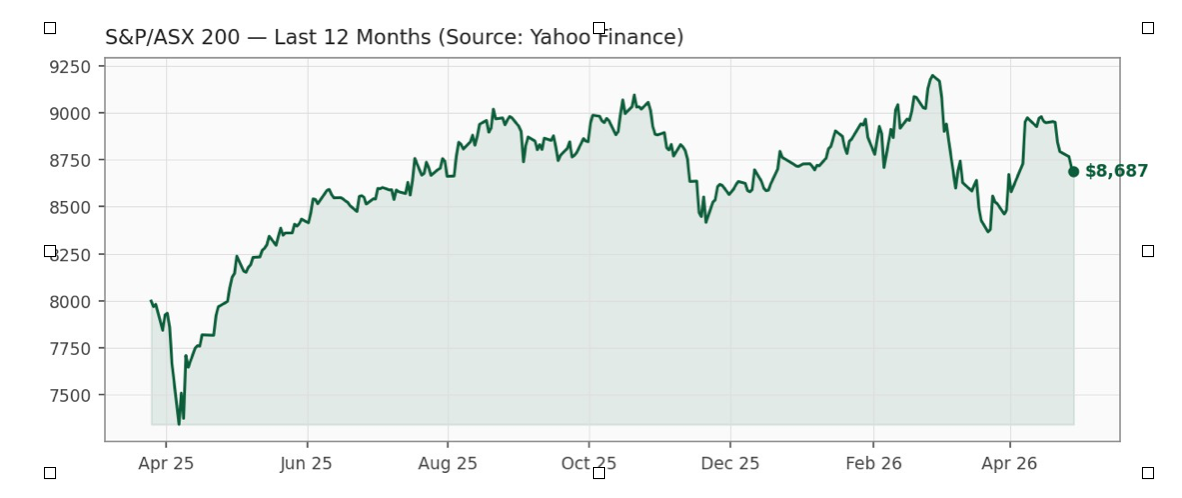
The ASX 200 (ASX:XJO) gained +2.2% in April to close near 8,666. Useful, but the local market is still down
-2.4% over six months and well below the February high of 9,203. Australia is recovering, not roaring.
WTI crude (NYMEX:CL1!) closed April at $106, up +4.5% on the month but more importantly up +74% over six months. Brent crude (ICEEUR:B1!) sits at $112, up +72% over six months. The Hormuz risk premium has only partly bled out.
Gold (COMEX:GC1!) finished at $4,628, broadly flat for April but up +16.2% over six months. Silver (COMEX:SI1!) at $75 is up +55.4% over six months. Copper (COMEX:HG1!) added +8.0% in April and is up
+19.1% over six months. Precious metals and copper continue to do exactly what we said they would do in Brace for Runaway Inflation.
The AUDUSD (FX:AUDUSD) closed at 0.71, up +4.2% on the month. Welcome news for the macro picture, less so for offshore earners.
The Australian Inflation Print
The Australian Q1 2026 CPI dropped on 30 April, the day this report covers. It is the most important release of the month.
Headline CPI rose +1.4% in the quarter, lifting the annual rate to 4.6%. That is up from 3.7% in February and well above the RBA’s 2-3% target band.
The trimmed mean, the RBA’s preferred core measure, came in at 3.3% on an annual basis. Unchanged from February.
The market is reading the unchanged trimmed mean as a green light for patience. We disagree.
Headline at 4.6% is hot. Housing inflation is +6.5% annually. Transport is +8.9%. Food is +3.1%. None of those are about to roll over. The unchanged trimmed mean buys the RBA short-term cover, but it does not change the destination.
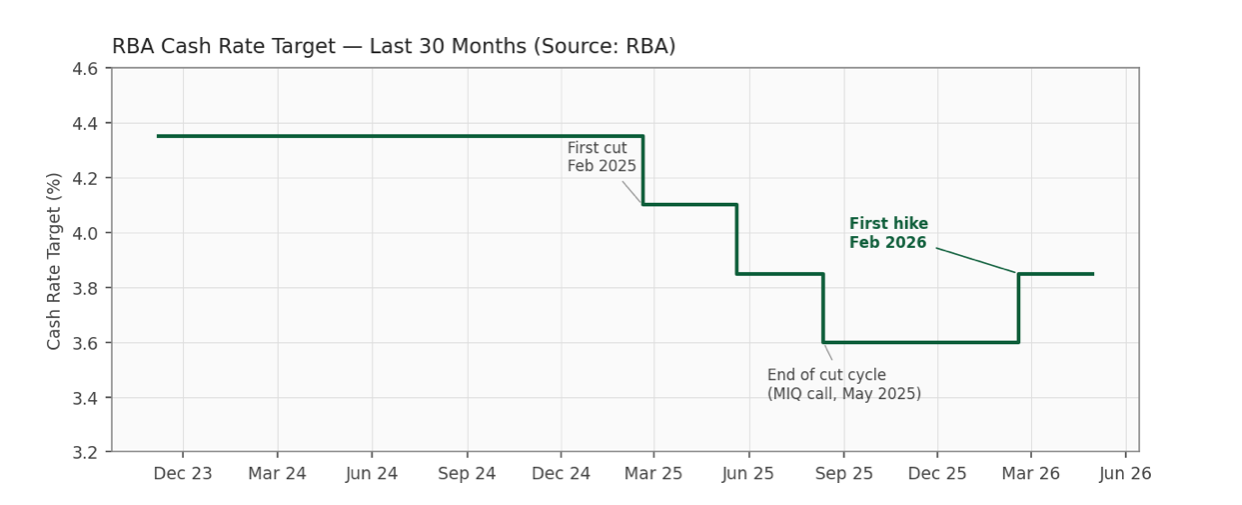
We called the end of rate cuts in May 2025. The market priced 3 hikes for 2026 by March, with a fourth half priced in. Today’s print is consistent with that path. The RBA may take its time, but the next move is up.
Inflation remains the biggest underestimated risk to global markets. This print reinforces our view.
The US 10-year Treasury yield (TVC:US10Y) backed up from 4.31% to 4.39% over April. Yields rising while equities also rose tells you the bond market is gradually accepting that the cuts narrative was wrong. Not pricing them out yet. Just stretching the timeline.
Sector Themes
The six-month picture is what matters. April moves are mostly noise around bigger trends.
Information Technology (ASX:XIJ) — Pessimism Beginning to Crack
The local tech sector closed April at 1,763, up +13.3% on the month. Sounds great until you realise the sector is still down -38.4% over six months from the November high.
This is the agentic-AI panic we covered in The Great ASX Tech Smackdown. The market decided that agents would replace SaaS. We argued the opposite, that quality platforms with data, trust and distribution become the operating systems agents live inside.
Xero (ASX:XRO) closed April at $80, up +6.6% on the month but still down -44.8% over six months from
$145. WiseTech Global (ASX:WTC) finished at $42.72, up +12.4% in April but -38.2% over six months. NextDC (ASX:NXT) ripped +25.8% to $14.24, helped by data centre tailwinds we have flagged repeatedly.
The April bounce in the names everyone hated is the first sign that pessimism is cracking. We continue to think this is the most attractive setup on the ASX. Substantial upside if the businesses keep executing.
Health Care (ASX:XHJ) — Still Bleeding, Still Underpriced
Health Care closed April at 25,321, down -8.7% on the month and down a brutal -34.4% over six months from the November high. The worst-performing sector on the board, and it has not yet found a floor.
CSL Limited (ASX:CSL) closed April at $124.37, off -11.7% on the month and down -30.3% over six months. Telix Pharmaceuticals (ASX:TLX) recovered +9.8% in April to $15.00, but that is still -6.7% over six months and well below the 12-month high of $29.64.
We covered the case for ASX biotech in Don’t Overlook ASX Biotech in March. The thesis hasn’t changed. CSL is a fortress shooting itself in the foot, an execution problem rather than a broken business. TLX is a growth story that keeps getting interrupted.
When a sector down -34% over six months is still selling off into month-end, you are watching capitulation form. Capitulation creates the next bull market. Substantial upside on the other side, even if the timing is uncertain.
Materials (ASX:XMJ) — Copper Wins, Iron Ore Loses
Materials closed at 22,700, up +4.3% on the month and up +15.7% over six months. The split underneath is doing the heavy lifting.
BHP Group (ASX:BHP) added +6.6% on the month to $53.72 and is up +23.6% over six months. Rio Tinto (ASX:RIO) finished at $167.40, up +3.7% in April and +26.0% over six months. Copper is the driver, not iron ore.
Fortescue (ASX:FMG) closed at $19.65, off -3.3% in April and down -7.7% over six months. Pure iron ore exposure is the laggard. Iron ore (TIO.AX) itself is down -55.8% over six months. The China property recovery is still sputtering.
We have flagged copper as a structural beneficiary of data centre power demand and electrification for some time. April’s $6.03/lb close confirms the trend. Junior miners in copper, gold and silver are not yet priced for this environment.
Energy (ASX:XEJ) — Volatility Around a Strong Run
Energy closed at 11,064, down -2.7% on the month. The lazy take is that energy is rolling over. The right take is that energy is up +28.1% over six months on the Iran/Hormuz run-up, and a 2-3% pullback is just volatility.
Woodside Energy (ASX:WDS) finished at $33.55, off -4.3% on the month but up +35.3% over six months. Santos (ASX:STO) closed at $8.00, broadly flat in April but up +26.8% over six months. Both names are sitting near 12-month highs.
The Iran situation has not resolved. Until it does, the geopolitical premium in oil is real. Energy producers also benefit from the inflation thesis through their cash flows. The April pullback looks more like consolidation than topping.
Consumer Staples (ASX:XSJ) — Pricing Power Still the Trade
Staples closed April at 12,031, down -4.1% on the month but still up +2.3% over six months. A soft April after a long run, not a regime change.
This is the inflation-winners trade we wrote about in Brace for Runaway Inflation. Companies with pricing power. Supermarkets. Utilities. Insurers. They pass costs through. Earnings hold up. Multiples don’t compress.
If the inflation thesis plays out the way we think, this is the boring trade that keeps working through the cycle.
Financials (ASX:XFJ) — Stuck
Financials closed at 9,557, up +2.9% in April but down -1.6% over six months. The big four banks are battling margin compression as rates plateau ahead of the next move higher. Macquarie (ASX:MQG) was the standout, up +16.4% in April to $235, helped by alternative-asset and infrastructure tailwinds the mortgage banks don’t have.
If we are right on rates, Financials sit between two forces. Higher rates eventually mean better net interest margins. But the path includes credit stress. We are watching, not chasing.
Standout Stocks and Stories
NextDC (ASX:NXT) — +25.8% in April
NextDC was the stock of the month. The +25.8% move to $14.24 is the market finally remembering what we have been saying about the structural energy demand from AI workloads. NextDC owns the dominant ASX-listed data centre platform. The thesis is unchanged. If you sat through the March selloff, the April rally was the reward.
Macquarie Group (ASX:MQG) — +16.4% in April
While the big four banks limped through April, Macquarie put on +16.4% to $235. Macquarie isn’t a mortgage bank. It’s an infrastructure and alternative asset manager with global reach. In an environment where infrastructure investment is booming and alternatives are catching capital flows, Macquarie’s pipeline looks strong. The valuation is full, but the business model is a different game to the big four.
CSL Limited (ASX:CSL) — -11.7% in April, -30.3% over six months
CSL closed April at $124.37, the worst major large cap on the board. The plasma franchise remains world-class. The execution has been poor. The board changed the CEO in February. The market is voting on whether the new management can stop the unforced errors. At this price, the stock is pricing the moat as eroding. We don’t think it is. The rerate, if it comes, will be meaningful.
BHP Group (ASX:BHP) — +6.6% in April, +23.6% over six months
BHP at $53.72 is a copper proxy more than an iron ore stock. April’s commodity moves keep validating that read. With copper still well below the levels needed to unlock new supply, the structural deficit story remains in play. Reasonable valuation, real dividend, leveraged to the right commodity for the next decade.
May Outlook for the ASX — Key Themes and Risks
1. The next RBA meeting
The 30 April CPI print is hot. The market currently has another hike priced in for the second half of 2026. If the RBA’s language at the May meeting hardens, expect a sharp move in rate-sensitives and the AUD. If they hold the line for a few more months, REITs and consumer cyclicals get a brief reprieve. Either way, the destination is the same.
2. China and iron ore
Iron ore is down -55.8% over six months. China’s property recovery is the swing factor. Any meaningful stimulus from Beijing reverses this fast and changes the picture for FMG and pure iron ore plays. Watch the spot price. A move back above US$110/t would matter.
3. Iran and oil
The Hormuz situation is in slow-grind mode, our base case from This Too Shall Pass. Oil is sitting comfortably above pre-conflict levels. A re-escalation puts WTI back toward $115. A breakthrough takes it toward $80. Either move resets the inflation conversation in days, not months.
4. Tech and biotech inflection
Both sectors are -34% to -39% over six months. Both started bouncing in April. If the bounce continues into May with company-level confirmation (a strong Xero quarterly, a TLX clinical update, a CSL stabilisation), the rotation back into quality oversold names becomes the trade of the year.
In Summary
April was a pivot month for global equities. The S&P 500 and Nasdaq-100 both made fresh highs. The ASX 200 lagged, dragged by a brutal Health Care sector and a still-weak iron ore complex.
The big macro tells were the inflation print and the bond market. CPI hot, trimmed mean unchanged, US 10-year yields drifting higher. The path is still towards more rate pressure, not less, and inflation remains the biggest underestimated risk to markets globally.
The sector rotation underneath is clear. Commodity-leveraged names and pricing-power businesses keep working. Tech and Health Care are sitting on six-month declines deep enough to start attracting attention. Energy is volatile around a strong run. Iron ore is still in trouble. None of this is a surprise, and most of it lines up with what we have said throughout the year.
We go into May watching the RBA, the next round of company quarterlies, and any movement in the Iran situation. Our positioning bias remains the same. Pricing power. Copper. Selective in oversold tech and biotech. Patient with the rest.
As always, don’t forget to check out our stock recommendations, CEO interviews and other articles at themarketsiq.com.
