
Opening Snapshot
We were going so well. But peace didn’t hold, and by month end the market was pricing that in too.
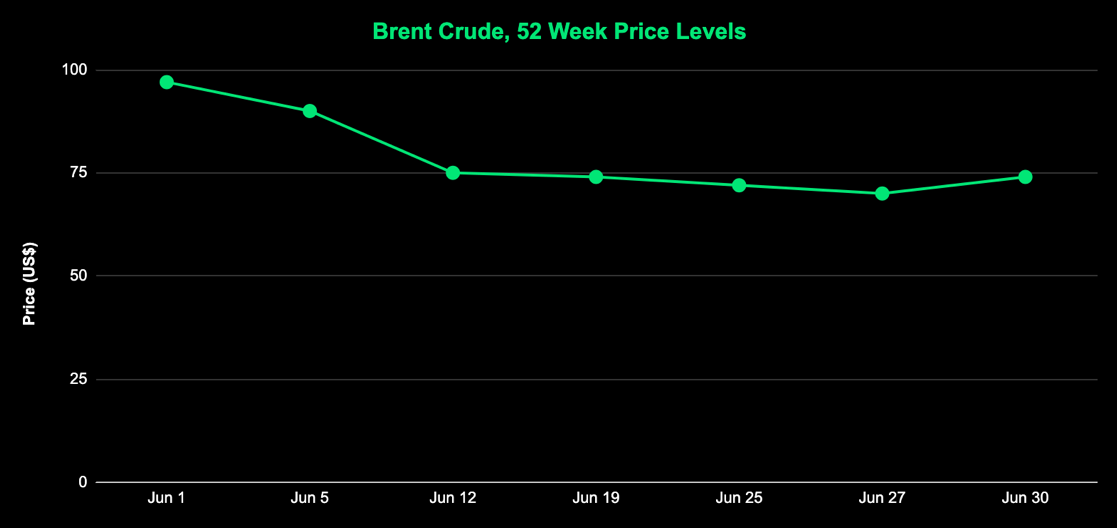
The Iran ceasefire, confirmed June 12 and signed June 17 in Versailles following the G7, did what four months of geopolitical pressure could not (BBC, 2026). Brent crude fell from $97 to
$75, a 22% drop in a single month and the worst since the pandemic crash (CNBC, 2026). The reopening of the Strait of Hormuz pulled a major supply risk premium out of oil markets (Al Jazeera, 2026).
Then the ceasefire cracked. In the final week of June, Iran struck commercial vessels in the Strait of Hormuz and the US retaliated against Iranian military sites for the third time in three weeks. Iran hit US positions in Bahrain and Kuwait in response. Oil prices partially reversed, and by June 30, Brent had clawed its way back to around $74 (Trading Economics, 2026).
Cheap oil is a tax cut for consumers and a headache for central banks still fighting inflation. It also says something about demand, and the demand story points to China. Supply relief or growth warning, that tension defined June, and it’s still unresolved heading into July.
Data sourced from Trading Economics and CNBC, June 2026
Market Snapshot | |||
Metric | Start of June | End of June | Change |
Brent crude (US$/bbl) | 97 | 74.01 | -23.7% |
ASX 200 (index) | 8,735 | 8,779 | +0.5% |
AUD/USD | 0.72 | 0.69 | –4.0% |
Gold (AUD/oz) | 5949 | 6267 | +5.3% |
The Ceasefire That Ceased Before the Month Even Ended
On June 25, Iran’s Islamic Revolutionary Guard Corps struck a Singapore flagged cargo vessel, the Ever Lovely, with a drone. On June 26, President Trump accused Iran of a “foolish violation” of the ceasefire after four drones targeted ships transiting the strait, and US Central Command struck Iranian missile and drone storage sites and coastal radar positions (Al Jazeera (a), 2026; Al Jazeera (b), 2026).
Iran’s IRGC retaliated on June 27 and 28, hitting US linked positions including Ali Al Salem Air Base in Kuwait and the US Fifth Fleet headquarters in Bahrain (CNN, 2026). Both governments called the strikes violations of their sovereignty (Tribune India, 2026). Three rounds of US strikes on Iranian targets in three weeks.
Both sides accused the other of breaching the Islamabad Memorandum. Trump warned that Iran “will no longer exist” if attacks continued. Iran’s IRGC threatened to halt all diplomatic processes if the US struck again (CNN, 2026).
A UN maritime agency paused vessel evacuation operations in the strait after the June 25 attack. Fresh talks were scheduled for Doha, and by month end both sides had agreed to step back from direct conflict to let those talks proceed (Investing.com, 2026). Whether that framework survives into July is an open question.
Oil priced all of this in real time. Brent fell to a four month low near $69 -72 by June 27 as fighting resumed, then rebounded to $73 -74 by June 29 -30 as traders reassessed how fragile the ceasefire really was. It closed the month at $74.01, down about 24% for June, but the last week clawed back a chunk of the mid month decline (Trading Economics, 2026; CNN, 2026).
Australian Market
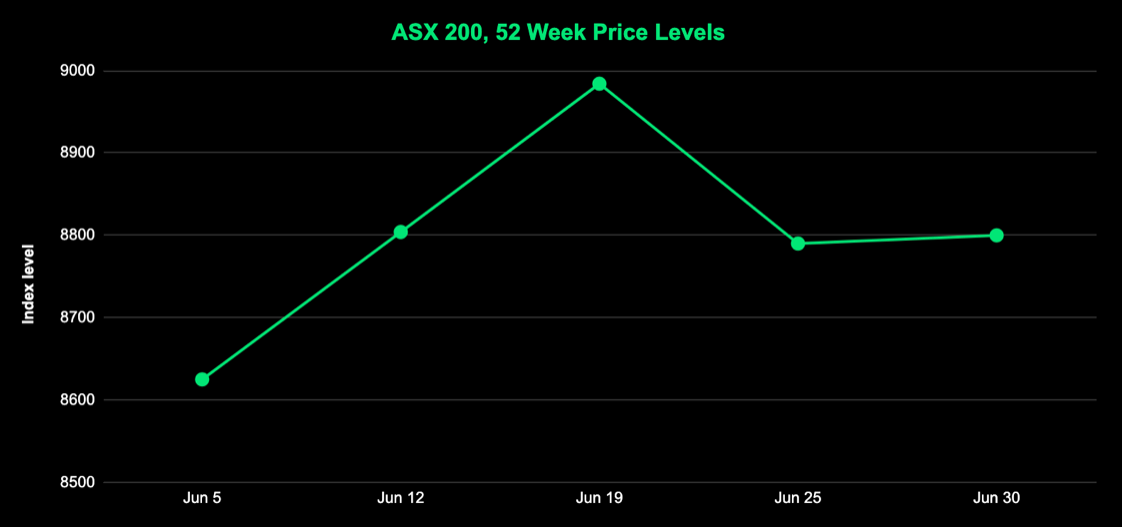
By the end of the first trading week of June, the ASX 200 had fallen 0.7% to close at 8,625, sitting below key moving average levels heading into the long weekend (ABC, 2026).
On June 12, the ceasefire was confirmed and the index jumped 170.80 points, 1.98%, to close near 8,804, back above its 200 day moving average for the first time in weeks. Nine of eleven sectors finished green (MarketIndex, 2026).
The rally kept running the following week, touching a nine week high near 8,984 before easing back to test support around 8,780 -8,800 by June 25, as a hawkish US Federal Reserve meeting and a renewed slide in commodity prices weighed on sentiment (IG, 2026).
The index closed June at 8,779, up roughly 0.5% for the month, its third straight monthly gain, even as it drifted in a narrow range on the final trading day amid signs of deescalation between the US and Iran (Trading Economics, 2026). Capital moved from the things that benefited from the war to the things that didn’t. Energy derated. Healthcare led. The ASX 200 rebalance formalised a rotation that had already been running for months (S&P Dow Jones Indices, 2026).
Data sourced from MarketIndex, IG and Trading Economics, June 2026
Inflation and Interest Rates
Rates and Inflation | |||
Metric | Value | Prior | Direction |
RBA cash rate | 4.35% | 4.35% | Hold |
US Fed funds rate | 3.5-3.75% | 3.5-3.75% | Hold |
Headline CPI (Aus, YoY) | 4.0% | 4.2% | Down |
Trimmed mean CPI (Aus, YoY) | 3.6% | 3.4% | Up |
Unemployment (Aus) | 4.4% | 4.5% | Down |
The RBA met on June 16 and held the cash rate at 4.35%, its first pause after three consecutive hikes to open the year (RBA, 2026). Governor Bullock said the pause is just that, a pause, and further tightening stays on the table if inflation refuses to cooperate (Westpac IQ, 2026).
The economy is slowing, which would normally support rate cuts. But underlying inflation is still too high, and that leaves the RBA with limited room to move. The May CPI, released June 24, showed headline inflation easing to 4.0% from 4.2%, almost entirely on cheaper fuel (ABS, 2026). The trimmed mean, which the RBA watches more closely, rose to 3.6% from 3.4% (ABS, 2026). Lower oil prices bought some relief at the headline level. The domestic pressure underneath it is still sticky.
Labour data was mixed rather than clearly weak. Employment rose by 40,300 in May and unemployment eased to 4.4%. Hours worked fell 1.1%, which points to some softness under the surface (ABS, 2026). Enough evidence of slowing activity. Not enough to say core inflation is under control. August 11 is the next live meeting.
Across the Pacific, the US Federal Reserve moved the other way. Kevin Warsh’s first meeting as chair held rates at 3.5% -3.75% but dropped the easing bias entirely. Nine of eighteen dot plot members now project a hike before year end, and the 2026 PCE inflation forecast was lifted to 3.6%, up from 2.7% in March (CNBC, 2026). Bank of America is now calling for three US rate rises in 2026 (CNBC, 2026).
Sector Themes
Sector Themes | ||
Sector | June Direction | Key Driver |
Energy | Derated | Oil fell 22% on ceasefire relief |
Materials | Whipsawed | Peace rally then China rate hold |
Healthcare | Led gains | Weak AUD, flight to cashflow |
Technology | Sold off | June 23 global chip rout |
Energy
Energy was the obvious loser. Oil fell 22%, and energy stocks fell with it. Woodside, Santos and Karoon all derated as the market repriced a world where crude trades in the low $70s instead of the war inflated $90s (Stocks Down Under, 2026). Eleven trading days wiped out the earnings tailwind that had been padding the sector since February.
The real question is whether this is a structural reset or a temporary correction on ceasefire relief. The evidence points toward temporary. The Islamabad Memorandum that Trump and Pezeshkian signed on June 17 is a 60 day framework, not a settled treaty (UCSB, 2026).
Israel wasn’t a party to it and has said it doesn’t consider itself bound by the ceasefire terms covering Lebanon (PBS, 2026). Iran and the US haven’t agreed on whether Hormuz transit stays toll free once the 60 day window closes, and strikes continued on both sides into the last week of June, after the memorandum was already signed (Cultura Colectiva, 2026). The oil market priced a durable peace into an agreement both signatories are already testing at the edges. The IEA’s assessment that cumulative infrastructure damage now exceeds the combined severity of the 1970s oil shocks points to a multiyear rebuild regardless of how the ceasefire holds (Al Jazeera, 2026). That doesn’t square with a one way derating of the sector. If the rebuild takes years the way Libya’s did after 2011, the supply story isn’t resolved just because the headline says ceasefire. Risk in energy sits to the upside through July, the opposite of how the sector traded for most of June.
This energy fragility is not limited to the Middle East. Russia’s reported purchase of Indian gasoline to tackle domestic shortages (Reuters, 2026) adds another wrinkle. India has been buying discounted Russian crude, refining it, and then supplying fuel back into global markets, including cargoes reportedly flowing back toward Russia through traders. This
points to an energy market that is still rerouting around shortages, damaged capacity and political risk.
Materials
Materials was the most volatile sector in both directions. On June 12, materials surged 4.06% on the peace rally. Genesis Minerals rose 10.83%, Pantoro rose 9.57%, Liontown rose 9.82%, PLS rose 9.76%. On June 19, the sector cratered 4.03%, with gold miners, uranium and aluminium all down more than 5%. Deep Yellow fell 9.88%, Newmont fell 6.66%, Alcoa fell 6.88% (MarketIndex, 2026).
China kept lending rates on hold for a thirteenth consecutive month (Investing.com, 2026), and mining fell in seven of nine sessions through the back half of June on growth concerns. The first half of the move was relief, the ceasefire pulling geopolitical risk out of cyclicals.
The second half was demand concern, as China’s hold disappointed investors looking for stronger stimulus (Reuters, 2026).
That hold is one data point, and the market has treated it as a verdict. Worth being more careful with it. China’s factories and China’s households aren’t telling the same story right now. Industrial output accelerated through May even as retail sales fell for the first time since December 2022, and exports have stayed resilient enough that the People’s Bank of China has felt no urgency to ease (Reuters, 2026). That’s a two speed economy, not a uniformly weak one. The mining sector sold off on a read that thirteen months without a rate cut means thirteen months of muted demand. The underlying data splits between an
export-facing industrial side holding up and a property linked domestic side that keeps softening. Iron ore and base metals track both halves unevenly. Compressing a mixed signal into one bearish narrative overstates what a single rate decision actually tells you.
Gold held at extraordinary levels in AUD terms, as high as AUD 6,267 and near AUD 5,949 even on the worst days (Melbourne Gold Company, 2026). The miners didn’t follow. The instinct is to call this forced selling and buy the dip. That may be right. Miners carry exposure to labour, diesel, equipment and debt, all of which got more expensive in the same inflationary period that drove gold higher. Before calling the gap a dislocation, check whether margins are actually expanding at current spot prices. If they aren’t, the market might be doing its job correctly.
Healthcare
Healthcare was the clean winner of the month. CSL went from $97.91 on June 5 to $116.32 by June 19, including a 7.62% single day surge (Bez-Kabli, 2026).
Three things converged. Capital running from risk landed on businesses with real earnings instead of promises for tomorrow. The AUD’s slide toward three month lows below $0.69 inflated the translated value of USD earnings for offshore earners, and CSL, ResMed and Cochlear all earn significantly in USD. The 2026 -27 Budget’s proposed CGT reform,
effective from 1 July 2027, may have tilted the market toward near term cashflow over deferred capital gains, exactly what these businesses produce (ATO, 2026).
That currency tailwind isn’t permanent. The AUD at 0.70 is a function of the rate gap covered above. If China delivers genuine stimulus and commodity prices recover, or the RBA hikes in August, the AUD strengthens and the translation gain partially unwinds. Investors in CSL are making an implicit currency call alongside their healthcare call, whether they’ve priced that in or not.
Technology
The global chip rout arrived locally on June 23, when a report tied to SK Hynix’s AI memory expansion plans sent Samsung and SK Hynix each down more than 12% in Seoul (CNBC, 2026). The selling rolled west. The Philadelphia Semiconductor Index fell 7.9%. Micron dropped 13%, SanDisk fell 13.6%, Nvidia gave back 4% (TradingKey, 2026). The Nasdaq
shed 2.21% (Reuters, 2026).
WiseTech Global wore another A$30 sell off as the global move washed through local tech (WiseTech, 2026).
The SK Hynix report was the trigger, not the cause. Part of the move was mechanical. Leveraged ETFs tracking Samsung and SK Hynix amplified the swing well beyond what the news justified, with single stock leveraged products posting average losses above 24% on the worst session (Bloomberg, 2026). The more durable story underneath it is still the rate environment. The AI buildout is being financed by debt at 3.5% -3.75% and possibly rising. SpaceX issued bonds the same week its stock was falling (Reuters, 2026). Every dollar of AI capex now carries a cost that has to be earned back. At zero rates that cost was negligible. Not anymore.
On the day the chips fell, US consumer staples rose 1.8% (Reuters, 2026). The money didn’t leave the market. It rotated. This same trade has been running on the ASX for months.
The ASX Rebalance
The June ASX 200 quarterly rebalance deserves its own note. Five names joined the index. Elevra Lithium, Electro Optic Systems, FireFly Metals, Kingsgate Consolidated and Minerals
260. Five left. Guzman y Gomez, IDP Education, SiteMinder, Temple & Webster and WEB Travel Group (S&P Dow Jones Indices, 2026).
Two gold miners, a lithium developer, a copper play and a defence and space specialist, in. Fast food, education, software, furniture and travel, out.
Standout Stocks and Stories
CSL (ASX:CSL)
The stock of the month. From $97.91 on June 5 to $116.32 by June 19, a 19% move in one of Australia’s largest companies (Bez-Kabli, 2026). Currency, rotation and quality converged. A weak AUD inflated offshore earnings, the market ran toward cashflow, and the business didn’t need a story about the future because it had earnings in the present. The thesis is intact. The next test is whether the AUD holds near 0.70 into the second half of the year, and the rates section above explains why that isn’t guaranteed.
Genesis Minerals (ASX:GMD)
Genesis rose 10.83% on June 12, then gave back a chunk of it as the sector sold off later in the month (MarketIndex, 2026). Gold wasn’t the problem. It held near AUD 5,949 even on the worst days (Melbourne Gold Company, 2026). The problem was positioning. Gold miners were crowded trades heading into the peace rally, and the selling that followed was index repositioning and margin management, not a fundamental reassessment of the orebody.
Watch for stabilisation once the forced selling clears.
SpaceX (NASDAQ:SPCX)
The month’s most instructive story. Priced at $135, opened at $150, briefly touched $225, then fell 16.4% in a single session by June 22, ending the month around $156 (Yahoo Finance, 2026).
The company lost $4.28 billion in Q1 2026 alone, on full year 2025 revenue of $18.7 billion (BitMEX, 2026). At its $225 peak it traded above 90 times revenue. Morningstar pegged fair value at $780 billion, roughly 48% below where the private market had been valuing it (Morningstar, 2026).
The round trip is better explained by float mechanics than a valuation correction. At IPO, 4.2% of the company was tradeable, tiny supply meeting enormous demand, and the clearing price told you about scarcity, not consensus value. From late August, around 319 million additional shares become eligible for sale. Some estimates put possible insider selling at up to 44% of the company by early September, a float expansion of roughly 900% (Yahoo Finance, 2026). The same scarcity that drove the stock to $225 inverts from late August. Starlink may be a genuinely good business. The IPO price never told you what it was worth.
WiseTech Global (ASX:WTC)
Down again in June. The CGT change in May repriced the entire long duration growth category, and the June chip rout gave it another leg lower (ATO, 2026). This isn’t a
bad-business argument. The tax treatment of its deferred gains got materially worse, and the discount rate applied to those far off profits moved against it at the same time. Both inputs in
the valuation model worsened together. Whether the derating is finished is the question worth sitting with.
July Outlook, Key Themes and Risks
The war premium is priced. The market needs a new reason to move higher, and that reason has to be earnings.
Bull case
The Doha talks hold and the ceasefire’s 60 day window survives without another exchange of strikes, so oil stays low for the supply relief reason rather than the demand scare reason. Headline inflation keeps easing on that basis, the trimmed mean follows with a lag, and the RBA’s pause becomes a hold. China’s industrial side stays resilient rather than tipping into its weaker half. The flight to cashflow broadens from healthcare into banks and infrastructure. The rotation grinds higher on fundamentals rather than fear.
Bear case
Oil could knock the market either way from here, and both scenarios are alive. One path has the ceasefire unravelling further. Both sides have already threatened to walk away from talks, and crude snaps back toward $90, reigniting the inflation fight the RBA just paused.
The other path has crude staying low, but for a worse reason. China’s two speed economy tips into its weaker half, the retail versus industrial split resolving toward real demand destruction instead of resilience. Cheap oil was actually a growth warning that the market mistook for a relief rally. Add the Fed delivering another hike after already dropping its easing bias, the SpaceX lockup expiries hitting in late August, and the chip sell off that started June 23 possibly turning out to be the first crack in a bigger unwind rather than just a leverage driven overshoot.
Base case
A two speed market. Cashflow, yield and hard assets grind higher while growth and discretionary names stay under structural pressure. Volatility stays elevated without trending sharply either way. The AUD holds near 0.70 as long as the gap between the RBA and the Fed persists.
Of the three, the base case fits the evidence best. The bull case needs the RBA’s pause to become a genuine hold, and the RBA’s own language argues against that. The board explicitly kept a hike on the table rather than signalling it was done. The bear case has two real, dated catalysts in the SpaceX lockup and an energy ceasefire already being tested at its edges, and both deserve tracking rather than dismissal. But neither one alone is evidence that growth assets globally are about to reprice in a sustained way, and the chip sell off’s leveraged ETF mechanics suggest June 23 overstated the underlying demand signal. The
single biggest swing factor for July is the August 11 RBA meeting set against whatever China’s next data print shows. If both confirm the higher for longer, two speed read this report has laid out, the base case holds. If the RBA backs off its hike bias while China’s domestic data turn genuinely soft rather than just bifurcated, the bear case has the stronger claim, and energy would be the place that shows up first.
In Summary
June delivered a peace dividend, then complicated it twice. Brent crude fell as much as 22% before partially rebounding in the final week. The ASX rose roughly 1% for the month (CNBC, 2026). Neither number captures what actually happened.
The real story was the rotation, and underneath it, a ceasefire that held for barely a week before both sides were trading strikes again. Capital moved from war era beneficiaries to peacetime cashflow plays. Healthcare led, energy derated, and the energy derating looks more fragile than the market priced mid month. The late June fire exchange in the Gulf is direct evidence of that.
Materials whipsawed in both directions and ended under pressure from a China growth signal that’s more split than it looks at first glance, plus chip rout contagion that owed as much to leveraged ETF mechanics as to fresh AI demand fears. The quarterly rebalance confirmed where the market had already been moving money, hard assets in, consumer discretionary and software out (S&P Dow Jones Indices, 2026).
Two central banks sat on opposite sides of the same problem. The RBA paused but kept a hike live. The Fed dropped its easing bias. The AUD stayed near 0.70 and kept the tailwind under offshore earners like CSL, ResMed and Cochlear, but that tailwind depends on a rate gap the RBA’s own language puts at risk by August, on an energy market whose calm the final week of June already called into question.
The war bid isn’t fully gone. It went dormant, then flared again before the month closed. With the peace rally now partly reversed and the ceasefire’s 60 day window still to be tested, the next leg higher needs to come from company earnings, not another macro relief trade. But macro risk hasn’t disappeared either. The base case is the more likely path through July, with energy, the Doha talks and the August 11 RBA decision the two places to watch for it to break.
