
The Rising Australian Dollar
Over the past year, the Australian dollar has strengthened notably against major global currencies, reaching over the US$0.70 mark in early 2026. This represents its highest level since February 2023. But what has been driving this move, and why has the AUD outperformed many of its global peers?
The answer lies in a combination of short-term market forces and longer-term factors that continue to support the current uprise in the Aussie dollar.
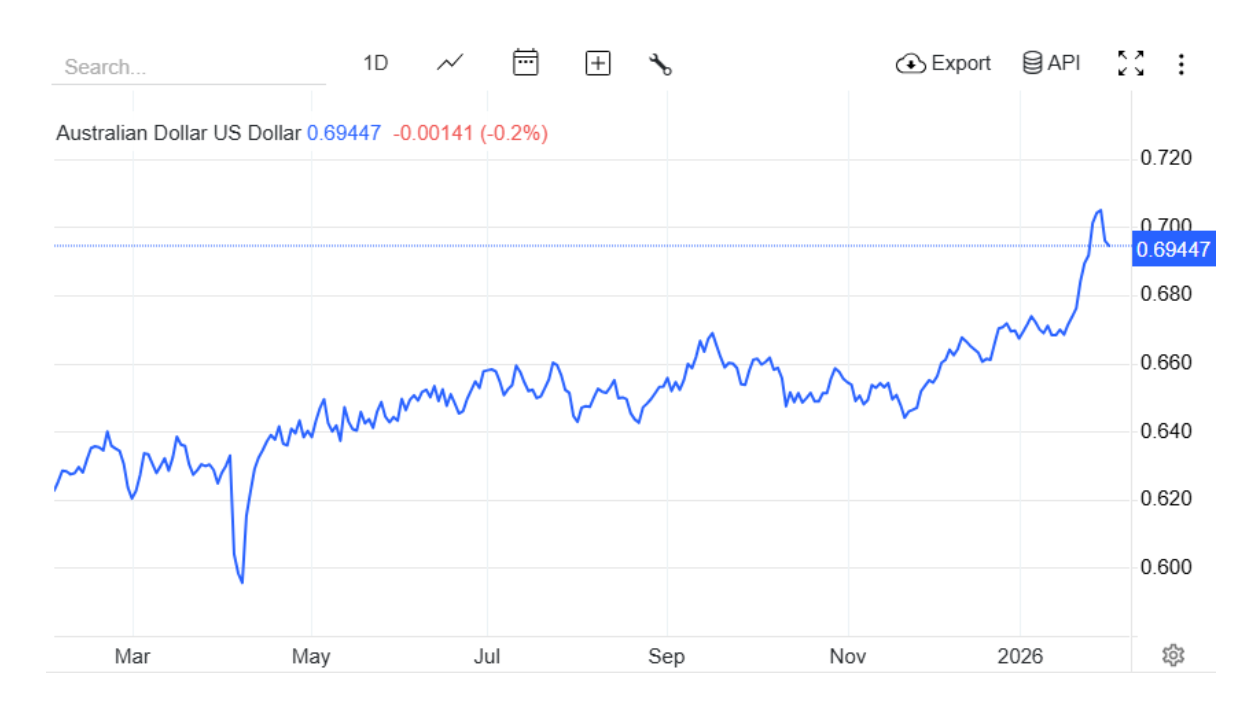
Source: (Trading Economics, 2026)
What were the main factors over the last year?
Interest rates
Why has Australia become so attractive to global investors?
Interest rate differentials have been a central driver of the Australian dollar’s appreciation against foreign currencies. After holding the cash rate at 4.35% since late 2023, the Reserve Bank of Australia began easing policy in 2025, cutting rates to 4.10% in February, 3.85% in May, and 3.60% in August 2025.
Despite these cuts, Australian interest rates remained relatively high compared to policy easing in the United States (Federal Reserve), Europe (ECB), and parts of Asia. This encouraged international capital to flow into Australian financial assets, increasing demand for the Australian dollar.
Australia continues to offer comparatively high real yields without political risk, capital controls, or foreign exchange intervention, positioning the AUD as a preferred high-yield G10 currency. (Mitrade, 2026)
In an environment where global investors are increasingly selective, could this stability be Australia’s biggest advantage?
The RBA’s policy stance was designed to balance inflation control with labour market resilience, reinforcing confidence in both the economy and the currency.
Critical Minerals
Why do commodities matter so much for the Aussie dollar?
Australia’s terms of trade continue to play a critical role in supporting the AUD, with imports and exports creating a substantial component of economic activity. Higher commodity export prices mean more Australian dollars are required to purchase the same volume of exports.
Rising commodity prices also stimulate investment, as exporters expand production capacity to capitalise on favourable pricing conditions. Foreign investors have shown increasing demand for Australian assets such as critical minerals, energy resources, and iron ore, which are sectors that remain fundamental to capital inflows.
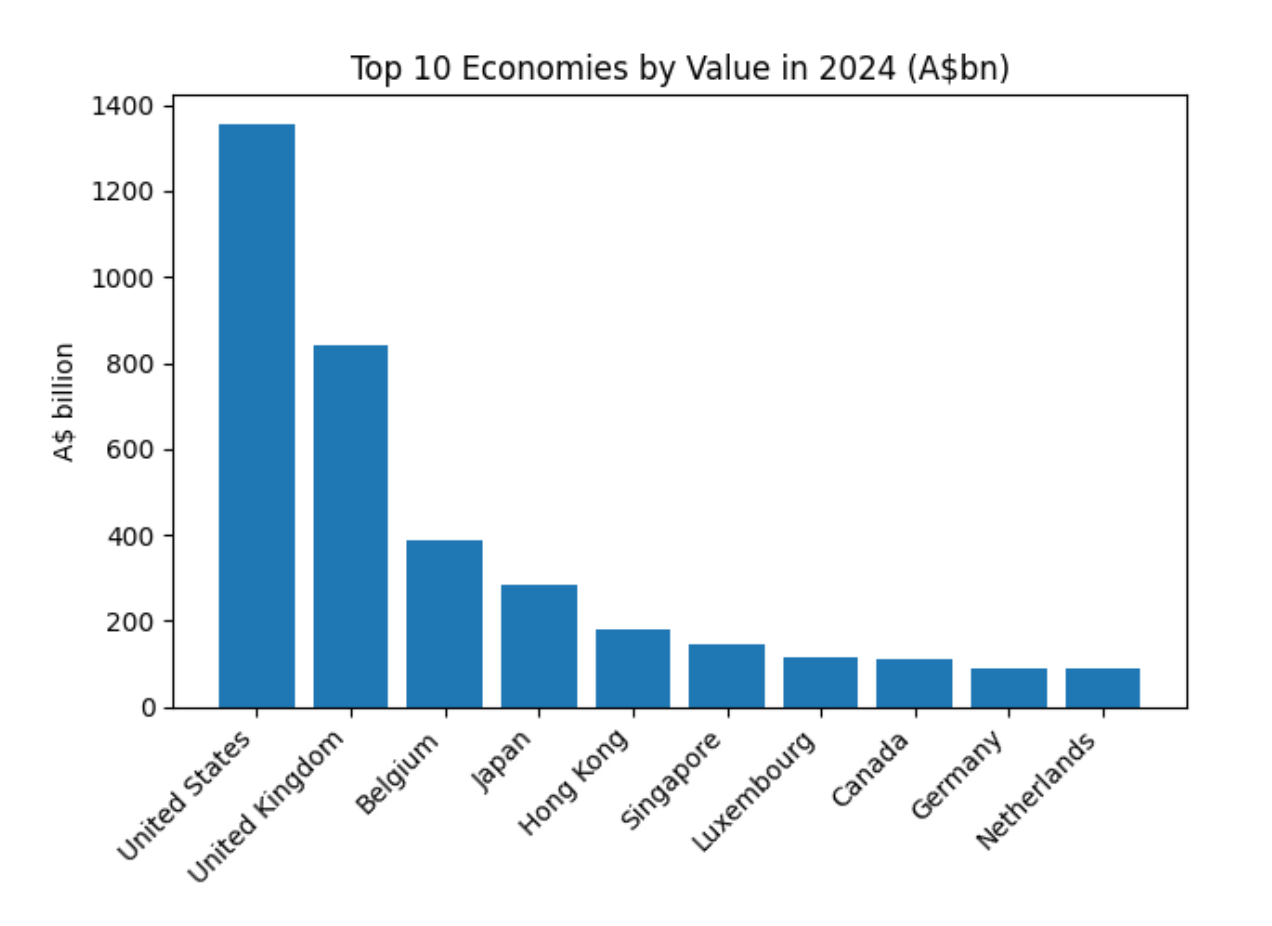
As of early 2025, foreign investment hit approximately $4,970.6 billion, with $1,280 billion in foreign direct investment, and the remainder coming from portfolio investment, such as foreign ownership of Aussie shares, financial derivatives, and other investments such as bank loans and credit. (Australian Department Of Foreign Affairs and Trade, 2025)
The graph below displays the top ten countries which invested in Australian goods to make up the $4.9 billion mark, with the US being at number one.
International Trade
Rising Trade Flows as a Key Driver of AUD Strength
Could trade flows be doing more of the heavy lifting than many expect?
Increased international trade has also contributed to the rise in the AUD, as overseas buyers increasingly transact in Australian dollars when purchasing resources.
Australia’s trade activity surged in late 2025 and early 2026, driven by record non-monetary gold exports, rebounding coal shipments, and elevated iron ore prices supported by Chinese stimulus measures. These factors helped the AUD rebound from five-year lows seen in early 2025.
China remains Australia’s largest trading partner, accounting for approximately 29% of total exports. Total two-way trade between Australia and China reached a record $309 billion in 2024–25, with Australian exports to China totalling $189 billion, supported by 19 free trade agreements and expanding demand beyond China.
The China/Australia Free Trade Agreement (ChAFTA) continues to secure market access for Australian goods, despite ongoing trade challenges.
Japan’s Influence
Why does Japanese monetary policy matter so much for the Australian dollar?
Beyond China, Japan has played a key role in supporting the AUD. Japan’s ultra-loose monetary policy, introduced in 2013 to stimulate growth and fight deflation, has encouraged institutions to seek higher-yielding assets offshore.
This environment has fuelled borrowing at low Japanese interest rates and investment into higher-yielding currencies such as the Australian dollar. This “carry trade” has significantly increased demand for AUD, pushing the AUD/JPY exchange rate to a 17-month high above 104 in late 2025.
Time-Bound Influences
Risk Tolerance
How much of the AUD’s movement is driven by tolerance rather than fundamentals?
The value of the AUD tracks broader financial markets and shifts in global risk tolerance, a measure of how willing investors are to take on risk. When expectations for economic growth improve, investors typically increase exposure to higher-yielding currencies such as the Australian dollar. (Reserve Bank of Australia, 2025)
This behaviour often coincides with stronger equity markets, where investors across asset classes respond similarly to improving sentiment.
Government Factors
Can fiscal strength really support a currency?
Australia’s relatively low government debt in contrast to other nations, such as Japan, the UK and US, and strong tax receipts continue to underpin confidence in the AUD. Low debt-to-GDP levels provide economic stability and resilience, while strong fiscal positions place upward pressure on interest rates and reinforce investor confidence in Australian assets.
Immigration
Australia’s post-COVID immigration surge significantly boosted the GDP and AUD rates, due to the boost in consumption, housing demand, and tax base.
This results in migrants, such as students, and skilled workers converting international funds to AUD, thus forming a non-reversable demand for AUD.
Global trade and the Aussie dollar
The Strong Aussie Dollar – What this means for Imports and Exports
A stronger dollar indirectly can affect businesses and industries as it makes our imports cheaper and exports more expensive. The bottom line is, any private, or public company that wishes to import goods may do so for cheaper, however to export will hurt the bottom line.
For example, shareholders in companies such as JB-HI-FI or Ampol Ltd would be benefitted, as bringing in goods such as tech and oil from overseas markets will be cheaper due to the Aussie dollar’s higher value compared to that of foreign currencies. However industries such as mining and energy may suffer significantly more, due to commodities being a strong suit for Aussie soil, and the export tariffs being significantly higher.
In recent times, due to the high Aussie dollar, companies that sell in the US, such as CSL Ltd, and Brambles Ltd are struggling, as these companies are “effectively 10% worse off when bringing those profits home” (Australian Financial Review, 2026)
Future Commodities
Could lithium be the AUD’s next long-term anchor?
Australia’s position as a leading global lithium producer continues to support the AUD, driven by rising demand for electric vehicles and energy storage.
As of February 2026, Pilbara Minerals’ stock price has risen by over 200% since 1 July 2025, while IGO Ltd has gained approximately 95% over the same period, despite the strong Australian dollar and elevated export costs.
Lithium carbonate prices surged approximately 25% during 2025 and currently sit near an 18-month high of US$13,292 per tonne. (The Motley Fool, 2026)
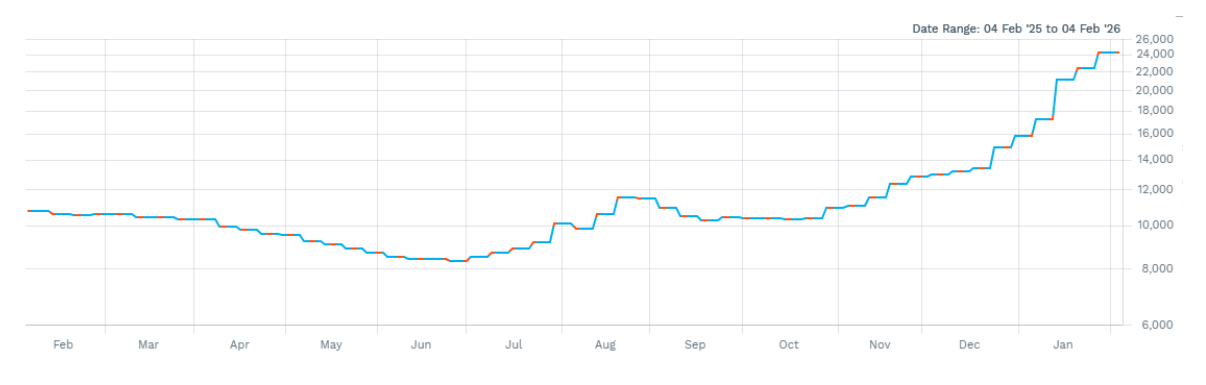
Source: Factset, 2026
How does the Aussie Dollar compare with foreign currencies?
The American Dollar
The Aussie dollar has just hit a 15-month high streak against the US dollar as of February 2025, currently sitting above $US0.70 cents compared to the US’ US$0.5887 value as a result of new tariff regulations.
Introduced in 2025, these tariff increases were proposed to encourage the manufacturing of US based goods and services as well as to bring back lost profits, thus essentially driving away a vast majority of foreign investment potential.
This displays the contrast between foreign investment in Australia and the United states, as Australia still holds a strong reputation of distributing its resources worldwide and welcoming globally developed goods and services.
KPMG chief economist Brendan Rynne stated, “If you want to travel to the United States, your Australian dollars are going to buy you more than they would 12 months ago,” Rynne said. “Having a nice holiday in the US will cost you a little bit less.”
The graph below displays the current state of both dollars,
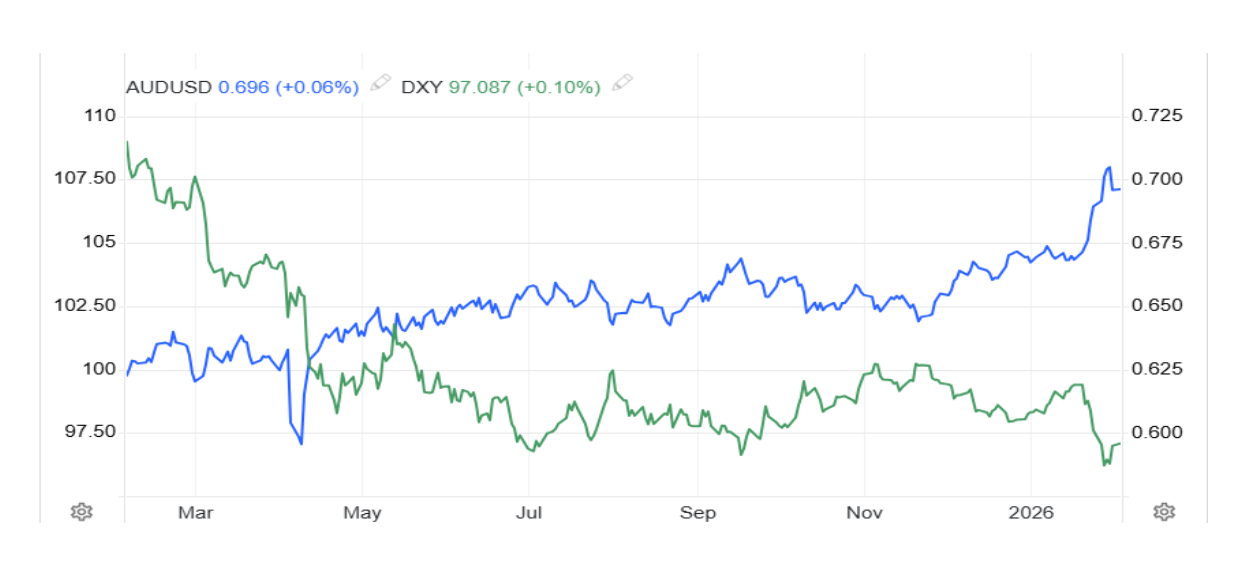
Source: (Trading Economics, 2026)
The Japanese Yen
Currently AU$1.00 is buying 108 Japanese Yen, thus it has been an under-performer against major currencies over the last 18 months.
The main factor that has been driving the Japanese yen to be an underperformer is their use of the dovish monetary policy, which prioritizes boosting investment and consumption over controlling inflation.
The dovish monetary policy aims to maximise employment, stimulate economic growth, and lower interest rates, and generally keeps the Japanese Yen weak and volatile, as the widening interest rate differential with other nations carry trades.
This therefore makes borrowing cheaper for consumers and businesses, therefore causing the Japanese yen to fall for international trade.
Happy Investing!
Vitti Capital Pty Ltd (ABN 13 670 030 145) is a Corporate Authorised Representative (001306367) of Point Capital Group Pty Ltd (ABN 41 625 931 900), the holder of Australian Financial Services Licence number 518031. The information contained in this website is only intended for the use of those persons who satisfy the Wholesale definition, pursuant to Section 761G and Section 761GA of the Corporations Act 2001 (Cth) (“the Act”).
Persons accessing this information should consider whether they are wholesale clients in accordance with the Act before relying on any information contained. Any advice contained in this communication is general only and does not consider your objectives, financial situation or needs, and you should consider whether it’s appropriate for you. This might mean that you seek personal advice from a representative authorised to provide personal advice.
If you are thinking about acquiring a financial product, you should consider the relevant Product Disclosure Statement or Prospectus (if there is one available) first. Our Privacy Statement is available at www.vitti.capital. Past returns do not always indicate future returns, and there is always a risk of loss when trading and investing.
