
Offshore Investing Opportunities for Australian Investors
Home bias is costing the Aussie investor’s return.
That’s the verdict, and the data backs it up. The ASX 200 trades on a forward P/E of about 18 times. Two sectors, banking and mining, dominate the index. In this context, can we say that an Australian only portfolio is diversified? No. It’s a leveraged bet on the domestic economy and the commodity cycle.
Even superannuation trustees are told to fix this. Under that Superannuation Industry (Supervision) Act of 1993 and Prudential Standard 530, trustees must manage concentration risk and diversity across markets, sectors and economic cycles. That mandate covers a pool of roughly $4.3 trillion in assets (Australian Bureau of Statistics, 2026). If the people managing the country’s retirement savings have to look offshore by law, then individual investors have every reason to ask the same question of their portfolios.
Where is the capital going?
The flow data tells the story plainly. Australians bought $57.6 billion of non US portfolio equity in 2025, ahead of the $43.3 billion that went into US shares. Japan, the UK and Ireland picked up the difference (Australian Bureau of Statistics, 2026). Offshore investing in 2026 gives you a spread out, safer bet.
Hong Kong is a big part of that spread. The Hang Seng trades on a forward P/E of roughly 10 to 11 times. Compare that with 18 times for the ASX 200 and 22 times for the S&P 500, with dividend yields near 4% to 5% (Sharewise, 2026). The IPO pipeline backs the valuation case with thirteen new listings in January 2026 alone, up 63% year on year (Sharewise, 2026).
Private credit is running a similar play. Offshore capital. Particularly from high net worth individuals, family offices and insurance companies, keeps flowing into Australian private credit funds. Local investors are doing the reverse by putting money into global private credit funds that chase returns that don’t move with the domestic cycle (Australian Investment Council, 2026).
What’s happening at home?
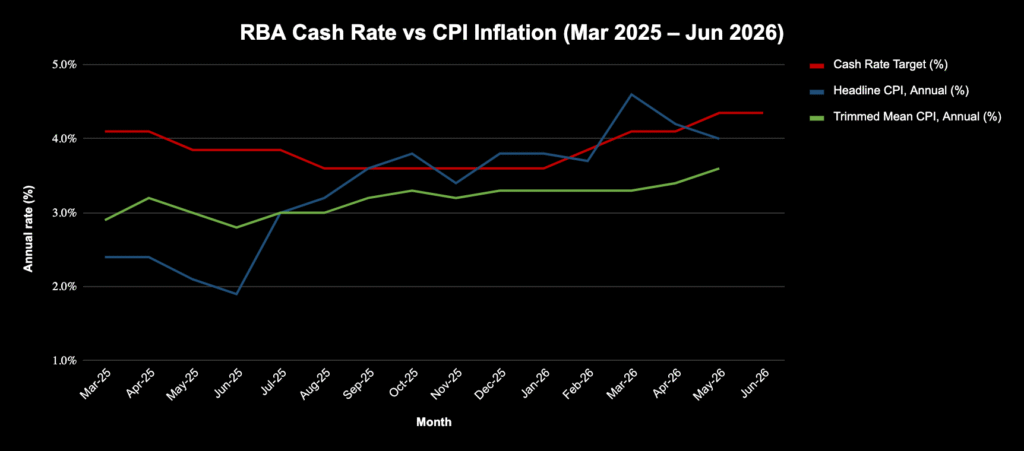
Part of the case for offshore exposure is what’s happening a home. The RBA has held the cash rate at 4.35% and headline inflation accelerated to 4.0% year on year, pushing above the target band and keeping a rate hike live (BlackRock, 2026). Spreading exposure across economies running different inflation and rate cycles gives you a hedge.
What decides the outcome?
Two things: currency and tax.
Offshore returns get translated back into Australian dollars, so currency does the deciding. Hong Kong makes the mechanism obvious as the Hong Kong dollar is pegged to the US dollar, so an Aussie investor’s exposure runs through AUD/USD. A stronger Aussie dollar eats into offshore returns and a weak one adds to them. Most international funds now come in hedged and unhedged versions as well. Investors should pick based on the role the position plays in the portfolio.
Australian tax residents declare worldwide income, foreign dividends, interest and capital gains included, even where tax was already paid overseas. A treaty in place usually means a foreign income tax offset, which stops the same dollar getting taxed twice (Australian Taxation Office, 2026). This isn’t a niche issue as more than 1.2 million Australians reported foreign sourced income in the 2022-2023 tax year (Everglow, 2026). The ATO also exchanged account data automatically with partner tax authorities. Offshore holdings show up whether an investor declares them or not.
The case for offshore allocation
The bull case is straightforward with valuation gaps this wide, Hong Kong at roughly half the ASX 200’s multiple, flow data confirming money is already moving and a legal mandate on superannuation trustees to diversify.
The bear case centres on the Australian dollar and the commodity cycle. If iron ore, copper and gold keep rallying, ASX earnings keep getting revised up and the AUD strengthens against major currencies. The combination drags on unhedged offshore returns at exactly the moment domestic assets are working.
The base case sits between the two. Commodity strength supports ASX in the near term, but the concentration problem doesn’t disappear because one cycle is favourable. A measured, permanent offshore allocation built through international ETFs, direct holdings, managed funds or global private credit addresses the structural issue regardless of which way the next twelve months break.
Where does this leave us?
None of this argues for dropping Australian equities. Franking credits are an amazing after tax advantage and home market familiarity provides comfort. We cannot, however, ignore that a portfolio built entirely within the ASX is a bet on one country and two sectors. Offshore investing fixes that, and doesn’t require abandoning anything that already works.
Disclaimer
Vitti Capital Pty Ltd (ABN 13 670 030 145) is a Corporate Authorised Representative (001306367) of Point Capital Group Pty Ltd (ABN 41 625 931 900), the holder of Australian Financial Services Licence number 518031. This communication contains general information only and does not take into account your objectives, financial situation, or needs.
Before acting on any information, you should consider whether it is appropriate to your circumstances. We recommend you seek personal financial advice before making any investment decision.
If you have not previously received a copy of our Financial Services Guide (FSG), it is available free of charge by contacting us or via https://vitti.capital/fsg/
Past returns do not always indicate future returns and there is always a risk of loss when trading and investing. Our Privacy Policy is available at https://vitti.capital/privacy-policy-2
