
Listed Investment Companies inAustralia: Are LICs Right for Your Portfolio?
What is an LIC?
A Listed Investment Company is an ASX listed company whose whole business is to hold a
portfolio of investments in Australia or overseas. When you buy shares in an LIC, you’re not
buying the underlying assets directly. Instead, you’re buying shares in the company that
owns them.
That company is run by a board and typically managed by a professional investment
manager who selects and adjusts the portfolio.
This structure makes LICs part of the broader family of listed investment companies in
Australia that operate alongside Listed Investment Trusts (LITs) and Exchange Traded
Funds (ETFs), all of which give investors exposure to a diversified basket of assets through
a single ASX listed security.
How LICs differ from ETFs
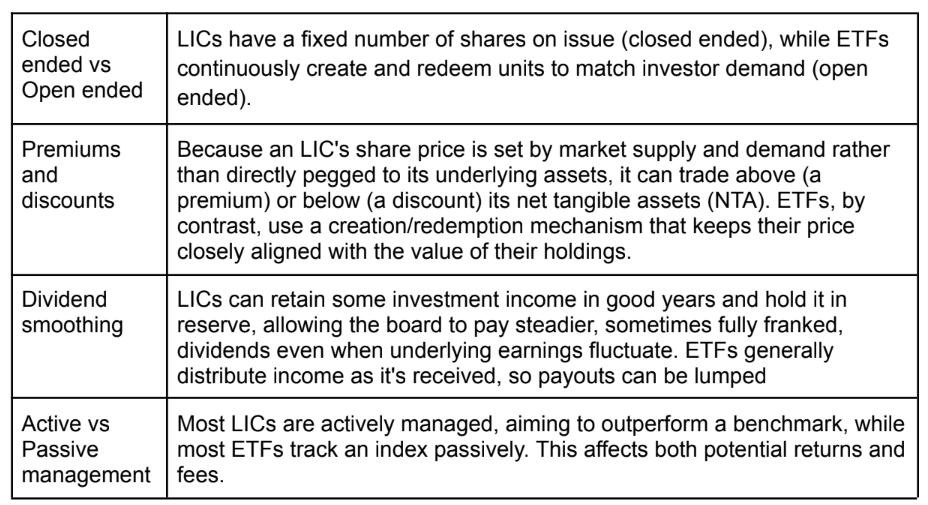
The structures differ in important ways:
Capital Gains
LICs have one tax advantage that ETFs don’t. An LIC classified as a “long term investor”
(rather than a “trader”) by the ATO can pass part of a profit to shareholders as a LIC capital
gain dividend, letting Australian resident shareholders deduct 50% of that amount. Only a
handful of LICs hold this status. As ETFs are structured as trusts, can’t use this.
This is set to change. From 1 July 2027, new legislation replaces the individual CGT
discount with cost base indexation and adds a minimum tax on capital gains. Companies
aren’t directly affected, since they never had the discount, but it’s unclear how the LIC
concession, built to mirror that discount, will adjust.
Potential Benefits of LICs
Income stability
For investors prioritising a reliable income stream (retirees, for example), the ability of LIC
boards to smooth dividends across market cycles is often the primary appeal.
Access to active management
LICs can offer exposure to strategies or asset classes (small caps, international equities,
private companies) that might be harder to access through a passive vehicle.
Potential to buy at a discount
When an LIC trades below its NTA, investors can effectively buy the underlying portfolio for
less than its stated value. Some investors specifically look for quality LICs trading at a
discount as a value opportunity.
Long track records
Some Australian LICs have operated continuously since the early to mid 20th century, giving
investors decades of performance history and governance practice to evaluate.
Risks and Drawbacks
Discount risk – The flip side of buying at a discount is that you can also be forced to sell at one. Discounts
can persist for years, and there’s no mechanism that guarantees convergence with NTA.
- Liquidity – Smaller LICs can have thin trading volumes, which may widen the gap between buy and sell prices and make it harder to enter or exit a position at a fair price.
- Fees and performance – Active management comes at a cost, and not all managers outperform their benchmark after fees. It’s worth comparing an LIC’s long term, after fee performance against a comparable index before committing capital.
- Concentration – Some LICs hold relatively concentrated portfolios, which can amplify both gains and losses compared with broader market exposure.
Where LICs Might Fit in a Portfolio
For investors building equity investment exposure in Australia, LICs can play a specific role rather than serving as an entire portfolio solution on their own. They may suit those who:
- Want income with some smoothing across market cycles
- Are comfortable with the added variable of share price relative to NTA
- Have a long term horizon and can ride out periods when a discount doesn’t close
- Want exposure to active managers in specific niches (small caps, global equities, or unlisted assets)
They may be less suitable for investors who want their share price to track the underlying assets closely, prefer lower cost, passive exposure, or need to trade in and out of a position quickly.
The Bottom Line
LICs aren’t a guaranteed edge over ETFs, rather a distinct structure with a distinct risk and reward profile, one that rewards research into a fund’s management history, fee structure, and typical premium or discount to NTA. As with any investment decision, it’s worth weighing your own income needs, time horizon, and risk tolerance, and considering a conversation with a licensed financial adviser before adding LICs to your portfolio.
Author Bio:

Tushti Chaturvedi is an Investment Analyst at Vitti Capital, specialising in quantitative analysis and financial modelling. She holds a degree in Computer Science and Data Science from the University of Sydney, where she developed a strong foundation in Python, machine learning, and data-driven problem solving. Tushti is passionate about bridging the gap between technical finance and everyday understanding, and enjoys writing educational content that breaks down complex investment concepts into clear, accessible insights for readers of all backgrounds.
