
Alternative Investments in Australia: Exploring Options Beyond Shares and Property
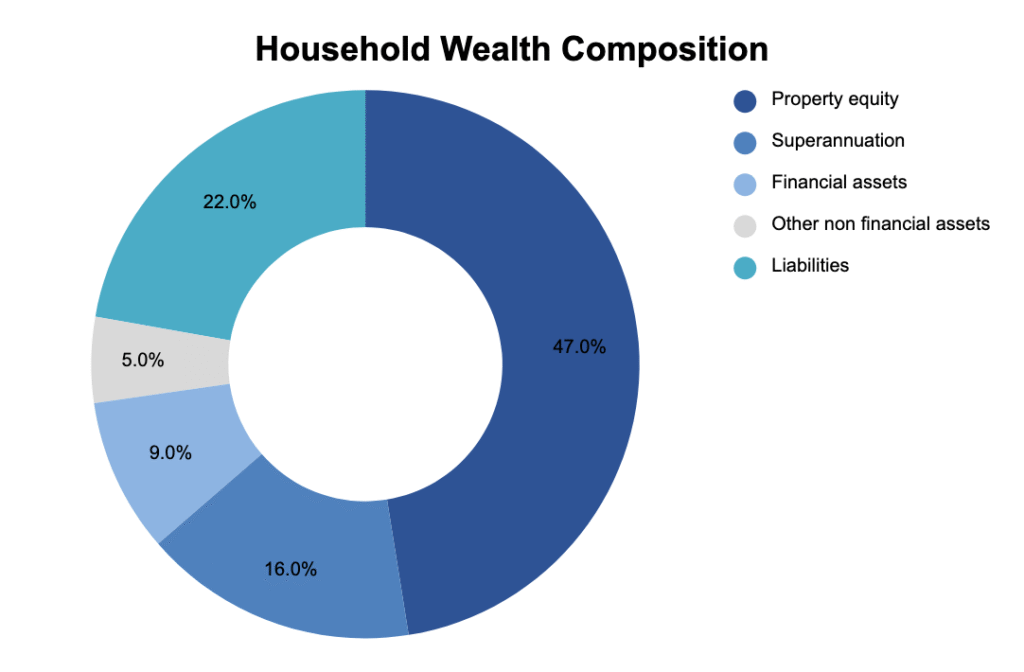
Australian household wealth hit $19.2 trillion in March 2026, split roughly 47% property, 16% super and just 9% financial assets held outside super (Wealthvieu, 2026; ABS, 2026).
That concentration is why it is worth looking at alternative investments.
| Asset Class | Liquidity | Risk |
| Private Credit | Not Liquid | Moderate |
| Private Equity / Venture Capital | Not Liquid | High |
| Venture Debt | Not Liquid | High |
| Real Assets and Infrastructure | Limited Liquidity | Low |
| Commodities | High Liquidity | Moderate |
| Hedge Funds | Some Liquidity | Moderate |
| LICs | High Liquidity | Moderate |
| Structured and Hybrid Securities | Some Liquidity | Low |
| Agriculture and Farmland | Not Liquid | Low |
| Collectables | Not Liquid | High |
| Crypto | Some Liquidity | High |
Private credit
Private credit is the fastest growing of the alternatives. It’s essentially lending money directly or via a pooling vehicle. AIC sized the Australian market at around $200 billion in AUM in 2025, though the RBA counts credit outstanding at $40-50 billion (ASIC, 2025; RBA, 2026). Lending personal capital comes with a higher risk of defaulting, but also means you can charge higher rates, giving you more return.
Private equity and venture capital
This is available only to wholesale investors like Vitti Capital’s clients. It allows investors to buy slices of unlisted companies. A fund manager raises money from investors, then buys stakes in mature private companies or early-stage startups (venture capital). They hold that stake while trying to grow the business, then sell it or take it public. The downside is that you’re locked in until the fund exits.
Venture debt
Venture debt funds lend to high-growth pre-profit companies by extending a term loan to a startup, usually alongside a recent equity raise, often receiving the right to buy equity later at a fixed price (warrants). Repayment is through scheduled interest and principal payments, providing a contracted interest rate and a repayment schedule rather than full equity risk, so there is some protection against underperformance. It is riskier than private credit because of how early-stage the borrowers are.
Real Assets and Infrastructure
This involves buying into physical, income producing, infrastructure such as toll roads, data centres, wind firms etc through an unlisted fund. Investors earn from clients paying to use it. Because the fees are often linked to inflation or locked into long contracts, income tends to hold steady even when markets are unstable.
Unlisted infrastructure returned 7-9% for the year to June 2026 (SuperGuide, 2026).
Commodities
A physical gold ETF holds bullion in a vault, with the unit price tracking the spot gold price. The GLobal X Physical Gold ETF (ASX:GOLD) holds $5.9 billion in bullion, which is up 150% over five years (ReviewETF, 2026). It pays no income, so the benefit is protecting purchasing power and diversification, not yield.
Hedge funds and market neutral strategies
Hedge fund managers bet both ways. They buy shares they think will go up and short sell (bet against) shares they think will go down. Because they’re not just riding the market up, their returns can hold even when the broader market falls. This, however, results in higher management fees than a normal fund.
Listed Investment Companies (LICs)
LICs raise a fixed pot of money once, then invest it in a portfolio of shares or other assets. After that, when you want to buy or sell, you’re trading with other investors on the stock exchange. Since the LIC itself doesn’t have to sell its underlying investments to give you your money back, the manager can keep paying steady dividends even in a downturn as they are not being forced to sell at bad prices.
Structured and Hybrid Securities
These are a mix of a loan and a share. You give a company money and get a fixed payment, but there is a built in option to convert your investments to shares later, usually at a discount. This way, if the company does well, you can flip into equity and make profit, otherwise you are still owed a fixed return like a lender.
Agriculture and farmland
Rural Funds Group owns actual farmland and rents it out to farmers on long term leases. You get paid rent regardless of whether it is a good or bad season for that crop, plus the land might rise in value.
Driven by food demand and water access rather than interest rates, it moves somewhat independently of the rest of the economy.
Collectibles
Collectables are the purchase of physical assets that may be scarce or high value. This covers things like paintings, old wine, Birkins, etc. Investors must store and insure the items themselves. Any returns are only generated upon the sale; until then, the asset is illiquid. The appeal is that investors own a tangible asset within hobbies or interests.
Crypto
Crypto assets allow investors to buy into a digital, largely unregulated market. People partake because there is a potential for huge returns. Gains are only realised on disposal, and volatility can run sharply in both directions.
From 1 July 2027, the 50% CGT discount ends and will be replaced by cost based indexation and a 30% minimum tax on gains. Assets held at 30 June 2027 are values to split pre and post reform gains. For collectables (generally over $500), a defensible valuation of all collectibles is needed. CPA Australia estimates the national cost at $675-825 million (CPA,2026). For crypto, a coin or NFT bought before the cutoff and sold after has its gain split the same way, where pre 2027 keeps the old discount, post 2027 is indexed but taxed at the 30% floor.
Disclaimer
Vitti Capital Pty Ltd (ABN 13 670 030 145) is a Corporate Authorised Representative (001306367) of Point Capital Group Pty Ltd (ABN 41 625 931 900), the holder of Australian Financial Services Licence number 518031. This communication contains general information only and does not take into account your objectives, financial situation, or needs.
Before acting on any information, you should consider whether it is appropriate to your circumstances. We recommend you seek personal financial advice before making any investment decision.
If you have not previously received a copy of our Financial Services Guide (FSG), it is available free of charge by contacting us or via https://vitti.capital/fsg/
Past returns do not always indicate future returns and there is always a risk of loss when trading and investing. Our Privacy Policy is available at https://vitti.capital/privacy-policy-2
