
Alternative Data & Alpha in 2026
So where does alpha come from now?
Increasingly, it comes from alternative data
In 2026, alternative data has become a core competitive battleground for generating alpha, due to the significant benefits that it offers when it comes to predicting trends.
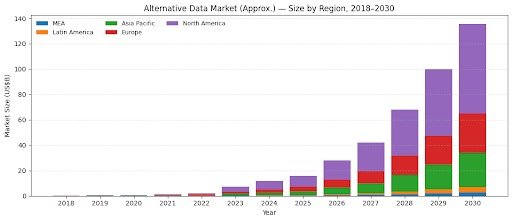
The global alternative data market was valued around USD $11.7 billion in 2024 and is projected to grow to even higher in 2026, continuing a strong growth trend (Research and Markets, 2026).
So what is Alternative Data?
Alternative data refers to information that isn’t usually found in company filings or traditional financial databases, and instead comes from real-world activity and digital behaviour, like credit/debit card transactions, satellite imagery of store traffic or factory output, web-scraped pricing data, geolocation foot-traffic trends, app downloads and engagement, shipping/logistics flows, and hiring or job-posting data (Data Army Intel IO, 2024).
Rather than waiting for quarterly earnings to understand performance, investors and businesses use these datasets to track what’s happening in near real time, which can improve investing, risk management, and strategic decisions (Data Army Intel IO, 2024).
This matters in 2026 because traditional financial data is widely available and quickly priced in, so the edge increasingly comes from signals that are faster and more behavioural. Adoption and spending show how mainstream it has become. A 2025 industry report found 90% of respondents are currently using alternative data, up sharply from prior years (Ecosystem, 2025).
Hedge funds and money managers spent about US$2.8B on alternative data in 2025 (up 17% year-on-year), showing how much firms are investing to find that edge. At the market level, Grand View Research estimates the global alternative data market was US$11.65B in 2024 and US$18.74B in 2025, with forecasts reaching US$135.72B by 2030 (Financial Investigator, 2025).
Why does Alternative Data matter in 2026 when making Investment decisions?
In 2026, financial markets are faster, more competitive, and more data-driven than ever before.
It enables faster and more responsive decision-making, because managers can see demand, customer behaviour, and operational activity in near real time rather than waiting for quarterly reports.
This improves forecasting and planning across pricing, inventory, supply chains, and budgeting by using live indicators like card spending, web traffic, foot traffic, shipping flows, and hiring trends to detect changes early (Deloitte, 2026).
It also strengthens risk management, as lenders and financial institutions can incorporate broader behavioural signals to improve credit assessment and early-warning monitoring, with some industry research estimating around 62% of financial institutions already use alternative data to enhance risk profiling and credit decisioning (Stripe, 2026).
At the same time, alternative data supports sharper customer and market insight, helping firms identify which products, regions, or segments are accelerating or slowing before traditional metrics catch up.
Hedge funds and asset managers now spend about US$2-3 billion a year on alternative data (around US$2.8B in 2025, up 17% from the year before). The market is also growing quickly overall, estimated at about US$11.65B in 2024 and forecast to reach roughly US$135.72B by 2030, which shows companies are starting to treat alternative data as a key part of how they make decisions. (Deloitte, 2026).
Where Alpha Opportunities Are Emerging?
Consumer Behaviour and Spending Trends
Today’s markets move fast. Instead of waiting for quarterly revenue numbers, investors analyse credit and debit card transactions, retail foot traffic, and mobile wallet data to gauge sales trends in near real time.
Early shifts in consumer behaviour, such as rising demand for a product category or weakening store traffic, can signal future stock performance before quarterly reports (Forbes, 2026).
Supply Chain & Trade Analytics
Global trade and logistics have become major drivers of economic activity and disruption. By tracking, shipping container volumes, port congestion patterns, vessel movements and freight rates.
Investors and businesses can see bottlenecks or demand surges before official supply chain reports are released. This is especially valuable in sectors like manufacturing, commodities, and retail.
Satellite & Geospatial Data
Satellite imagery isn’t just for weather forecasts anymore. High-resolution scans can estimate, store parking lot activity, factory output, energy usage and crop health and yields.
These signals help forecast company performance or economic trends before traditional data reveals them (SkyFi, 2025).
Tech Adoption & Innovation Metrics
Tracking how quickly companies are adopting new technologies, especially AI and cloud services, gives insight into competitive positioning and future revenue growth.
Investors use metrics such as job postings for specific tech roles, data centre expansions, software usage analytics and developer platform activity.
Investors and businesses can see bottlenecks or demand surges before official supply chain reports are released. This is especially valuable in sectors like manufacturing, commodities and retail.
Investors use metrics such as job postings for specific tech roles, data centre expansions, software usage analytics and developer platform activity (Forbes, 2026).
What are the Risks Involved?
Alternative data can be powerful, but it comes with real risks. The data can be messy or biased, which means it might show the wrong picture of what’s really happening.
As more investors use the same datasets, the advantage can disappear because the “signal” becomes crowded and already priced in.
AI models can also find patterns that aren’t real, and it’s easy to confuse correlation with causation, like thinking foot traffic means strong demand when it could be caused by a one-off event. On top of that, there are privacy and legal issues around how the data is collected, plus high costs and complexity to clean, store, and maintain it. (ECGI, 2022).
Happy Investing!
Vitti Capital Pty Ltd (ABN 13 670 030 145) is a Corporate Authorised Representative (001306367) of Point Capital Group Pty Ltd (ABN 41 625 931 900), the holder of Australian Financial Services Licence number 518031. The information contained in this website is only intended for the use of those persons who satisfy the Wholesale definition, pursuant to Section 761G and Section 761GA of the Corporations Act 2001 (Cth) (“the Act”).
Persons accessing this information should consider whether they are wholesale clients in accordance with the Act before relying on any information contained. Any advice contained in this communication is general only and does not consider your objectives, financial situation or needs, and you should consider whether it’s appropriate for you. This might mean that you seek personal advice from a representative authorised to provide personal advice.
If you are thinking about acquiring a financial product, you should consider the relevant Product Disclosure Statement or Prospectus (if there is one available) first. Our Privacy Statement is available at www.vitti.capital. Past returns do not always indicate future returns, and there is always a risk of loss when trading and investing.
