
Leveraging AI for Operating Leverage
Artificial Intelligence is no longer just a technology trend, it is becoming core infrastructure for modern investment firms. In capital markets, where margins, speed, and precision matter, AI is transforming how firms create operating leverage.
Artificial Intelligence (AI) has moved from a niche technology to a requirement function of modern business strategy, with 88% of organisations now using it in at least one business function (AI By Mckinsey, 2025).
Roughly 68% of Australian businesses have implemented some form of AI technology, with another roughly 23% planning to adopt within the next 12 months (CIO,inc, 2025). A steady jump is forecasted within AI market size in Australia over the next 7 years.
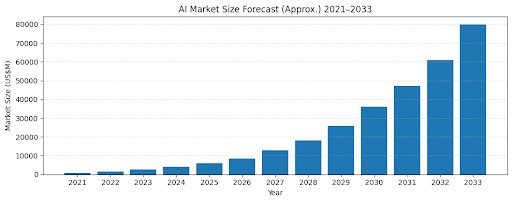
What this shows is growth in spending and adoption of AI technology in Australia. The reason analysts link that growth to cost reduction and efficiency is based on why businesses are adopting AI.
Because AI can improve efficiency and reduce costs, more companies adopt it. As adoption increases, spending on AI technology increases, which is why the market size grows in the graph.
Larger companies are adopting AI much faster, with around 60% using AI tools, compared to only about 20% of smaller businesses (CPA Australia, 2025).
By replacing ongoing costs like manual labour and repetitive tasks with AI systems that require more upfront investment but lower ongoing costs, businesses can operate more efficiently. Over time, this makes it easier to grow without increasing expenses at the same rate, which ultimately improves profitability.
So is AI really impacting the way in which industries distribute their funds and produce output?
What is Operating Leverage
Operating leverage is simply a company’s ability to grow its revenue faster than its costs. In basic terms, it shows how efficiently a business can scale. When a company has high operating leverage, even a small increase in revenue can lead to a much larger increase in profit (Hey Go Trade, 2026).
This happens because of the cost structure. Businesses typically have two types of costs, fixed costs and variable costs. Fixed costs, such as software systems, infrastructure, and salaried staff, do not change much as revenue increases. Variable costs such as hourly labour, transaction processing, and manual operational work tend to rise alongside revenue (Investopedia, 2026)
In a traditional model, scaling revenue often requires hiring more staff, increasing administrative capacity, and expanding operational resources. This means costs grow almost in line with revenue, limiting margin expansion.
AI changes this dynamic.
When AI systems are introduced, many tasks that were previously manual and variable become automated within a digital system. While there may be an upfront investment, once the system is built, it can handle far more volume without needing proportional increases in staff or costs. The cost of processing one more trade, generating another report, or reviewing another document becomes very low (UC, 2025).
From a financial perspective, this means revenue can grow 20-30% while operating expenses increase only modestly. The result is expanding operating margins, stronger EBITDA growth, and improved return on invested capital (Investopedia, 2025).
In essence, leveraging AI for operating leverage is about converting human-driven variable costs into scalable, technology-driven fixed costs, allowing profitability to compound as the business grows.
Where AI Creates Operating Leverage
Automating Task Routines
What if fund operations could scale faster, make fewer errors, and lower costs all without hiring more staff?
AI significantly enhances fund operations by automating repetitive and manual processes across the back and middle office, delivering measurable efficiency gains. In trade processing and reconciliation, AI systems can automatically match transactions between brokers, custodians, and internal records, with leading implementations reducing reconciliation time by 60-80% and cutting settlement errors by up to 30-50% (Stratechi, 2025).
AI-powered Robotic Process Automation (RPA) handles data entry, invoicing, and basic customer inquiries 24/7, with many financial institutions reporting 40-70% reductions in processing costs and productivity improvements of 20-30%, allowing operations to scale without proportional headcount growth (WNS, 2026).
Using natural language processing, AI can extract key data from loan agreements, financial statements, and subscription documents with accuracy rates often exceeding 90-95%, eliminating hours of manual review and reducing document processing time by more than 50% (Lleverage, 2026).
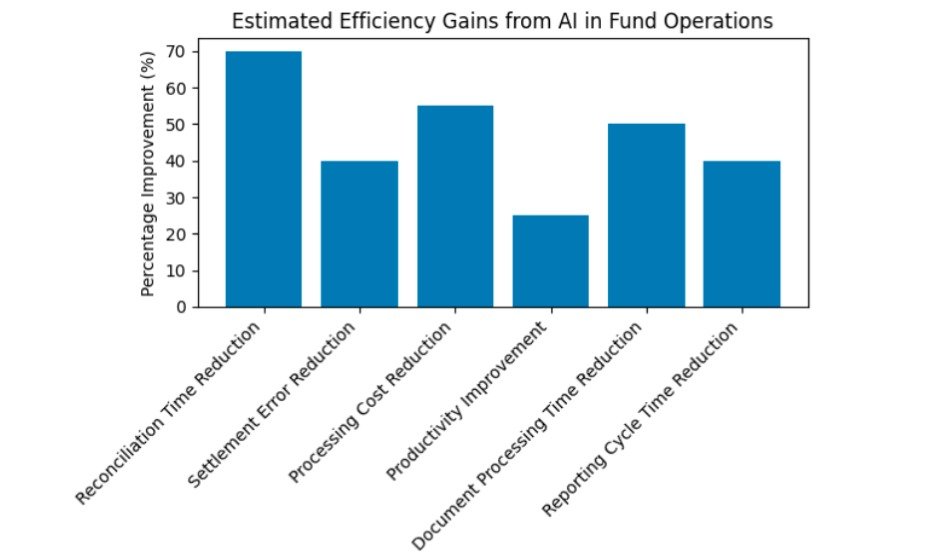
It can also generate investor reports, update performance dashboards, and monitor compliance breaches continuously rather than periodically, helping firms reduce reporting cycle times by 30-50% while improving overall risk oversight (Lleverage, 2026).
Customer Service and Support
AI-driven customer support creates operating leverage by allowing businesses to handle large volumes of customer inquiries without proportionally increasing staff. AI chatbots and virtual assistants can resolve repetitive queries such as billing, account access, and order tracking instantly and 24/7, while escalating complex issues to human agents when needed.
This reduces labour costs, improves response times, and allows support teams to focus on higher-value interactions. As customer numbers grow, the marginal cost per interaction remains low, enabling revenue to scale faster than operating expenses.
Marketing
AI enhances sales and marketing by using data to drive smarter targeting, higher conversion rates, and more efficient spending, all without proportionally increasing costs.
AI systems analyse customer behaviour, transaction history, browsing patterns, and engagement data to identify high-probability buyers. This allows businesses to automate lead scoring, prioritising prospects most likely to convert. Sales teams spend time on qualified leads rather than cold outreach, improving productivity per employee (Monday, 2025).
In marketing, AI optimises advertising spend in real time. It can automatically adjust bids, audiences, and content across digital platforms to maximise return on investment (ROI). Instead of increasing marketing budgets to grow revenue, companies improve efficiency and conversion quality.
AI also enables personalisation at scale, delivering tailored emails, product recommendations, and dynamic website experiences based on individual preferences. Personalised engagement increases customer lifetime value and retention without requiring larger marketing teams.
From an operating leverage perspective, once the AI infrastructure and data systems are built, campaigns, lead nurturing, and optimisation can run continuously with minimal incremental cost. As customer acquisition and sales volumes grow, marketing expenses do not rise at the same rate, expanding margins and improving scalability.
Operations and Process Optimisation
AI-driven operations and process optimisation improves internal efficiency by making systems faster, smarter, and more cost-effective. Rather than relying on manual oversight and reactive decisions, AI continuously analyses real-time operational data to enhance performance.
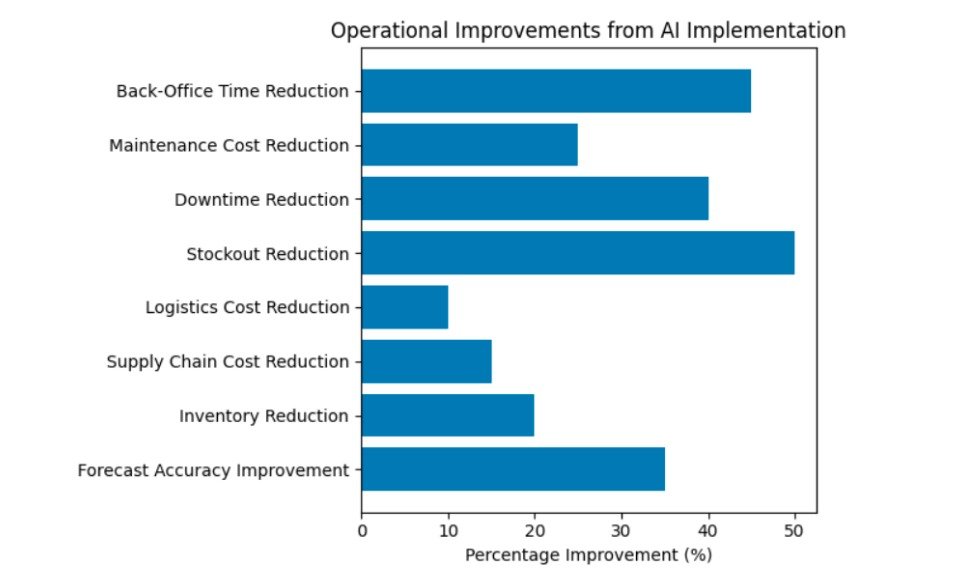
In demand forecasting, AI models using advanced analytics have been shown to improve forecast accuracy by 20-50%, while reducing inventory levels by 10-30% and lowering supply chain costs by up to 15% (McKinsey, 2025). Within supply chains, AI-driven routes and inventory optimisation can cut logistics costs by 5-15% and reduce stockouts by up to 50%.
In predictive maintenance, AI applications in industrial environments have reduced unplanned downtime by 30-50% and lowered maintenance costs by 10-40%, while extending asset life. In back-office operations, automation of procurement, contract processing, and compliance workflows can reduce processing times by 30-60% and significantly lower manual error rates (McKinsey, 2025).
From an operating leverage perspective, once these AI systems are implemented, they allow organisations to handle significantly higher transaction volumes without proportionally increasing headcount. As revenue scales, operational costs rise at a much slower rate, improving margins, capital efficiency, and overall resilience.
From an operating leverage perspective, once these AI systems are implemented, they allow organisations to handle significantly higher transaction volumes without proportionally increasing headcount. As revenue scales, operational costs rise at a much slower rate, improving margins, capital efficiency, and overall resilience.
AI also strengthens operating leverage through enhanced risk management and compliance monitoring.
Using natural language processing, AI systems can extract and analyse data from contracts, loan agreements, financial statements, and subscription documents with accuracy rates often
exceeding 90-95%, significantly reducing manual review time and improving operational efficiency.
Risk, Compliance, and Monitoring
AI also strengthens operating leverage through enhanced risk management and compliance monitoring.
Using natural language processing, AI systems can extract and analyse data from contracts, loan agreements, financial statements, and subscription documents with accuracy rates often exceeding 90-95%, reducing document review time by more than 50% (Deloitte, 2025).
Instead of relying on periodic manual checks, AI can continuously monitor transactions, flag anomalies in real time, detect potential fraud, and identify compliance breaches as they occur. This shifts risk oversight from a labour-intensive, reactive process to an automated, always-on system.
As transaction volumes grow, the marginal cost of monitoring additional activity remains minimal, allowing firms to scale operations while maintaining, or even improving, control and risk governance.
Risks and Implementation Considerations
While AI can materially improve operating leverage, it is not without risk. The benefits depend heavily on execution quality, data integrity, and strategic alignment.
First, implementation costs can be significant. AI systems require upfront investment in infrastructure, integration, data architecture, and talent. If deployment is poorly managed, cost overruns or delayed benefits can erode expected returns.
Second, AI models are only as strong as the data they are trained on. Poor data quality, fragmented systems, or inconsistent reporting can reduce accuracy and create flawed outputs. In forecasting or risk management, small errors can compound into material financial consequences.
Third, integration risk is often underestimated. Embedding AI into legacy systems can be complex, particularly in financial services or regulated industries. Without proper oversight, automation can create operational blind spots rather than efficiencies.
Cybersecurity and model risk are also key considerations. As businesses rely more heavily on automated decision systems, they become more exposed to data breaches, adversarial attacks, or algorithmic bias. Governance frameworks must evolve alongside technology adoption.
Finally, over-automation may reduce human judgment in areas where qualitative assessment remains critical. Effective AI strategies typically combine automation with human oversight rather than fully replacing it.
Happy Investing!
Vitti Capital Pty Ltd (ABN 13 670 030 145) is a Corporate Authorised Representative (001306367) of Point Capital Group Pty Ltd (ABN 41 625 931 900), the holder of Australian Financial Services Licence number 518031. The information contained in this website is only intended for the use of those persons who satisfy the Wholesale definition, pursuant to Section 761G and Section 761GA of the Corporations Act 2001 (Cth) (“the Act”).
Persons accessing this information should consider whether they are wholesale clients in accordance with the Act before relying on any information contained. Any advice contained in this communication is general only and does not consider your objectives, financial situation or needs, and you should consider whether it’s appropriate for you. This might mean that you seek personal advice from a representative authorised to provide personal advice.
If you are thinking about acquiring a financial product, you should consider the relevant Product Disclosure Statement or Prospectus (if there is one available) first. Our Privacy Statement is available at www.vitti.capital. Past returns do not always indicate future returns, and there is always a risk of loss when trading and investing.
