
Refinancing the 2026–27 “Maturity Wall”
The approaching 2026-27 “maturity wall” represents one of the most significant refinancing challenges facing global financial markets in the post-pandemic era.
While the concept itself, a concentration of debt maturities within a short period, is not new, the current environment is fundamentally different. Debt accumulated during the ultra-low interest rate period of 2020-2021 must now be refinanced in a structurally higher-rate regime, fundamentally altering both the cost and availability of capital.
As a result, the maturity wall is not simply a liquidity event, but a system-wide repricing of risk, with implications that extend across corporate balance sheets, sovereign finances, and global capital markets (mmgrea, 2026).
Source: (9Fin, 2025)
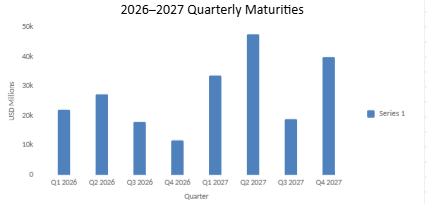
This graph displays the recent financial findings, which show that 237 publicly traded US and Canada-based companies have US$79.2bn of debt maturing in 2026, and US$140bn in 2027.
The scale of the upcoming maturity wall becomes clearer when looking at the concentration of high-yield debt maturities across 2026 and 2027.
Government Deficits and Refinancing
Governments globally continue to run high deficits. In Australia, the national debt is forecast to rise from $1,002 billion in 2025-26 to $1,257 billion by 2028-2029, driven by structural spending on health, education, and the NDIS (PBO, 2025).
In addition to this, the OECD said sovereign bond issuance in OECD countries is projected to reach a record US $18 trillion in 2026addition to this, The OECD said sovereign bond issuance in OECD countries is projected to reach a record US$18 trillion in 2026, up from US$12 trillion in 2022, while outstanding OECD government debt is projected to rise to 85% of GDP in 2026 (OECD, 2026).
At the same time, OECD-wide interest expenditure remains high at 3.3% of GDP, close to the highest level of the past decade (OECD, 2026).
This surge in sovereign issuance matters because it competes directly with corporate borrowers for investor capital. When governments absorb a large share of demand, borrowing costs across the market can remain elevated. As a result, firms entering refinancing cycles in 2026 and 2027 are doing so in an environment where capital is not only more expensive, but also more contested.
Structural Drivers
The origins of the maturity wall can be traced back to the extraordinary monetary conditions during the pandemic. Central banks maintained near-zero interest rates while implementing large-scale quantitative easing programs, creating abundant liquidity and historically cheap borrowing conditions. Firms responded rationally by increasing leverage and extending debt maturities (Fortress, 2026).
However, the rapid tightening cycle that began in 2022 reversed these conditions. Policy rates increased sharply, and inflation proved more persistent than initially expected. In Australia, for example, the central bank maintained elevated rates well into 2025 in response to ongoing inflationary pressures (RBA, 2026).
Importantly, this shift may not be temporary. Structural factors such as fiscal expansion, deglobalisation, and supply-side constraints suggest that the long-run equilibrium interest rate could remain higher than in the pre-pandemic era. If so, firms are not simply refinancing into a cyclical peak, as they are transitioning into a permanently more expensive funding environment.
The Corporate Transmission Mechanism
Higher refinancing costs affect corporations through several interconnected channels. The most immediate impact is on profitability. A rise in borrowing costs of 200 to 400 basis points, which is increasingly common, can significantly reduce net income, particularly for highly leveraged firms.
Beyond earnings, credit quality also deteriorates. Key metrics such as interest coverage ratios weaken as debt servicing costs rise, increasing the likelihood of credit rating downgrades (RBA, 2023). In more extreme cases, firms may lose access to capital markets altogether, particularly those in the speculative-grade segment.
However, the impact is not uniform. Firms with strong cash flows, low leverage, and pricing power are generally better positioned to absorb higher costs. In contrast, companies with weaker balance sheets face disproportionate stress. This divergence is expected to widen, leading to increased dispersion in corporate performance and credit outcomes (Marketplace, 2026).
Market Dynamics: Pricing, Liquidity, and Volatility
From a market perspective, the maturity wall is already influencing asset pricing. Credit spreads particularly in high-yield markets have begun to reflect elevated refinancing risk, although arguably not to the extent seen during periods of financial distress (Fitch Ratings, 2026). This raises a key question, that is, how much of the refinancing risk is already priced in?
If markets have underestimated the scale of the challenge, a reprice could trigger a sharp widening of spreads and a decline in risk asset valuations. Conversely, if risks are overstated, the refinancing cycle may proceed relatively smoothly, creating opportunities for excess returns in credit markets.
Liquidity will be a critical factor. A deterioration in market liquidity, whether due to macroeconomic shocks or financial instability, could amplify refinancing pressures and increase volatility. In such an environment, even fundamentally sound firms may face higher borrowing costs or reduced access to capital (S&P Global, 2025).
Sovereign Debt and Systemic Considerations
While corporate debt attracts most attention, sovereign refinancing risks are equally important. Governments are operating with elevated debt levels, and higher interest rates are increasing the cost of servicing this debt. In many developed economies, rising interest payments are gradually consuming a larger share of fiscal budgets, reducing policy flexibility (OCED, 2026).
Unlike corporations, sovereign issuers benefit from taxation powers and, in some cases, monetary policy tools. As a result, default risk remains low. However, the more relevant concern is fiscal constraint. Higher debt servicing costs may limit governments’ ability to respond to economic downturns, potentially slowing growth.
There is also a feedback loop between sovereign and corporate risk. Tighter fiscal conditions can weaken economic activity, which in turn increases corporate credit risk. This interconnectedness adds a systemic dimension to what might otherwise appear as isolated refinancing challenges (OCED, 2026).
When Refinancing Makes Sense
In this environment, refinancing is no longer just a mechanical process, it becomes a strategic decision. Companies must consider not only when to refinance, but how (Valley Bank, 2026).
Many firms are now refinancing 12 to 24 months ahead of maturity to avoid peak congestion periods and reduce rollover risk. Others are restructuring their capital by extending maturities, switching between fixed and floating rates, or incorporating hybrid instruments such as convertible debt.
Market timing also plays a significant role. During periods of strong investor demand, credit spreads can compress by 50 to 150 basis points, allowing firms to secure more favourable terms. However, waiting for optimal conditions carries its own risks, particularly in volatile markets (S&P Global, 2026).
The Risks of Waiting Too Long
Delaying refinancing can be costly. Debt issued at 3–5% during the pandemic may now need to be refinanced at 7–10% or higher, significantly increasing interest expenses. For highly leveraged firms, this can strain cash flow and push financial metrics into distressed territory (Mortgage choice, 2026).
Access to capital may also become more constrained over time. Lenders are increasingly selective, often imposing stricter covenants or reducing available credit. If too many firms attempt to refinance simultaneously, market capacity may be overwhelmed, driving yields even higher.
This creates a potential negative feedback loop: increased refinancing demand pushes up borrowing costs, which in turn increases financial stress and default risk. The concentration of maturities within a short period is what makes the maturity wall particularly dangerous (Macfarlanes, 2026).
Looking Ahead
The 2026-2027 maturity wall represents a critical stress test for global credit markets. The outcome will largely depend on how firms and policymakers respond to the evolving environment.
Companies that act early, by refinancing proactively, managing their maturity profiles, and maintaining strong balance sheets, are far more likely to navigate this period successfully. Those that delay may find themselves refinancing under pressure, facing higher costs, reduced flexibility, or, in extreme cases, restructuring risk.
In a world defined by higher interest rates and increased competition for capital, success will come down to timing, preparation, and disciplined financial management.
Happy Investing!
—————————————————————————————————-
Vitti Capital Pty Ltd (ABN 13 670 030 145) is a Corporate Authorised Representative (001306367) of Point Capital Group Pty Ltd (ABN 41 625 931 900), the holder of Australian Financial Services Licence number 518031.
This communication contains general information only and does not take into account your objectives, financial situation, or needs. Before acting on any information, you should consider whether it is appropriate to your circumstances.
We recommend you seek personal financial advice before making any investment decision.
If you have not previously received a copy of our Financial Services Guide (FSG), it is available free of charge by contacting us or via https://vitti.capital/fsg/
Past returns do not always indicate future returns and there is always a risk of loss when trading and investing. Our Privacy Policy is available at https://vitti.capital/privacy-policy-2
