
Growth vs Value Stocks in Australia: Which Strategy Fits Today’s Market?
Australia’s largest stock by market capitalisation crashed 10.4% in a single session as of the 13th of May. Commonwealth Bank (ASX:CBA) closed at $153.67 after dropping $17.90, wiping roughly $25 billion in market capitalisation.
This was amongst the largest single-day value destructions in Australian corporate history (IBTimes Australia, 2026). From its 52-week high of $191.98, the stock has now fallen more than 16% (The Bull, 2026). For investors weighing growth against value, CBA’s crash is one of the most useful data points available, and shows why value stocks aren’t always safe.
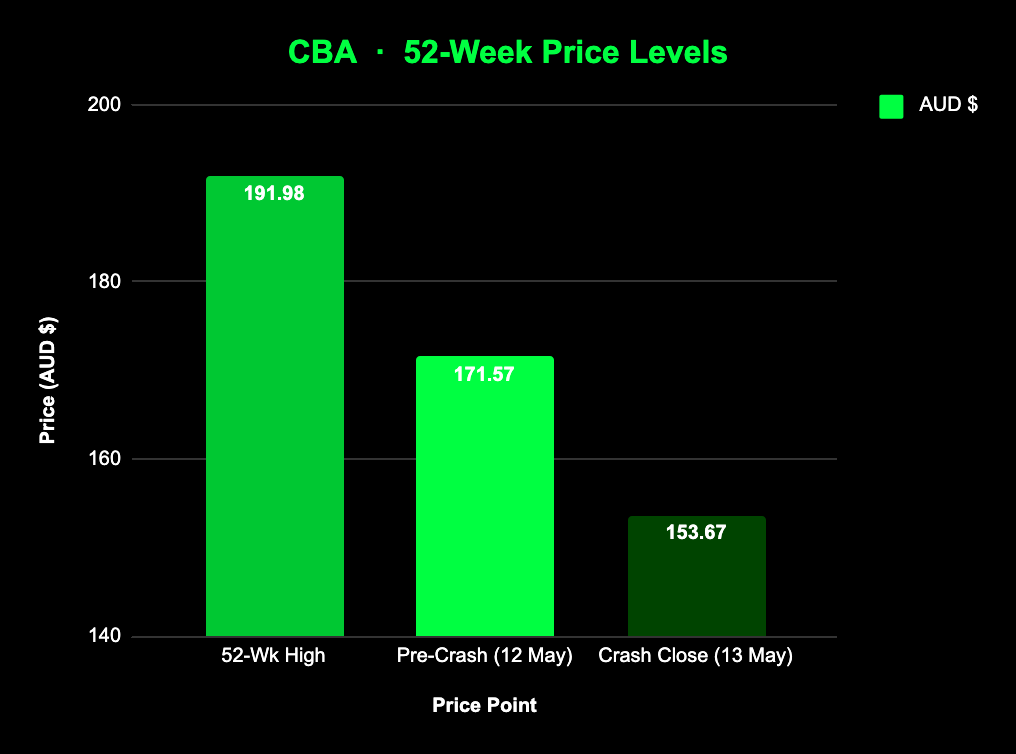
Data sourced from IBTimes Australia, 2026 and The Bull, 2026
What brought CBA down?
The three factors which drove the sell off include credit deterioration, policy shock and management caution. Personal loans more than 90 days overdue reached 1.71%, which is the highest number seen since before the pandemic, whilst home loan and corporate non-performing exposures also increased. The night before CBA’s trading update, the federal budget restricted negative gearing to newly built properties only, causing the market to immediately reprice the bank’s mortgage growth outlook; property investors account for roughly a third of new home lending and CBA derives more than half of its income from mortgages. Management then confirmed a darker view by lifting collective provisions by $200 million and increasing the weighting of its downside economic scenario, with CEO Matt Comyn citing “heightened macroeconomic risks” (Luke Hopewell, Switzer, 2026).
Why the rate environment matters differently this time
Value investing targets businesses generating meaningful cash today, purchased at a price below what that cashflow is actually worth. Growth investing means paying a premium today for earnings that will only materialise years from now. When rates rise, analysts apply a higher discount rate to projected profits, making distant earnings worth less in today’s money. Growth stocks, whose entire investment case rests on future earnings, get hit hardest.
While that logic holds for a standard rate cycle, CBA’s crash illustrates that Australia is navigating something closer to stagflation. April CPI sits at 4.2% year-on-year, trimmed mean inflation at 3.4%, and services inflation at 3.5%, which are all above the RBA’s 2-3% band. Yet Q1 GDP grew just 0.3% quarter-on-quarter while unemployment rose to 4.5%, its highest since late 2021 (Kerry Sun, Market Index, 2026). The Westpac-Melbourne Institute Consumer Sentiment Index fell to 80.6 in June, among the weakest readings in its fifty-year history (Westpac-Melbourne Institute, 2026), indicating that Australian consumers are increasingly reluctant to spend.
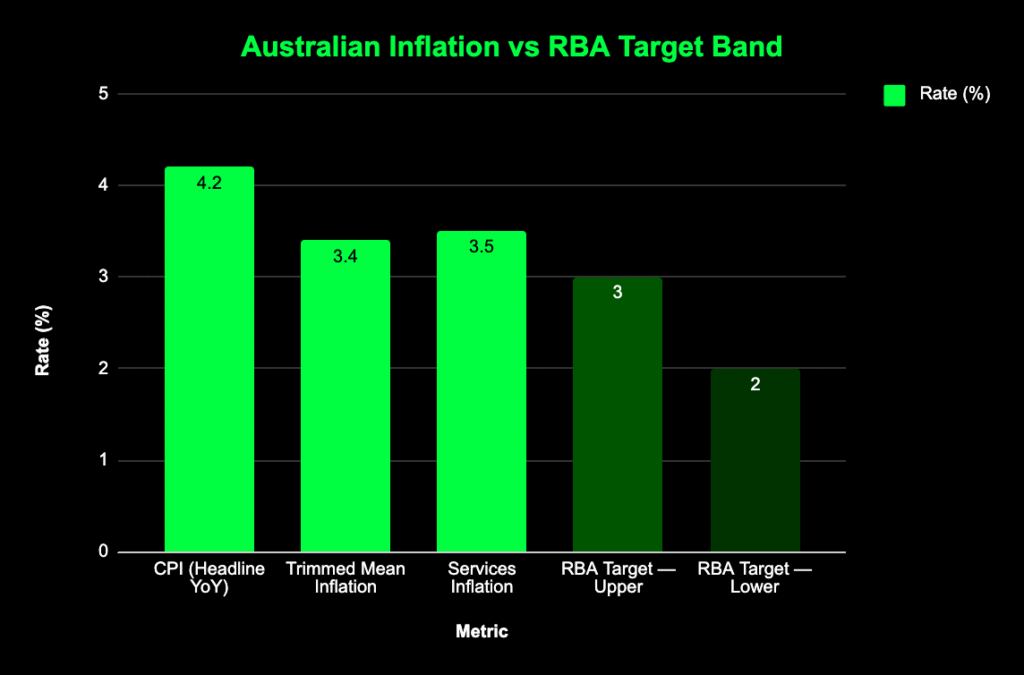
Data Sourced from Australian Bureau of Statistics, 2026
Stagflation does not just hurt growth stocks through higher discount rates. It hurts value stocks through rising credit losses, falling consumer spending and weaker earnings from the very businesses that are supposed to be safe.
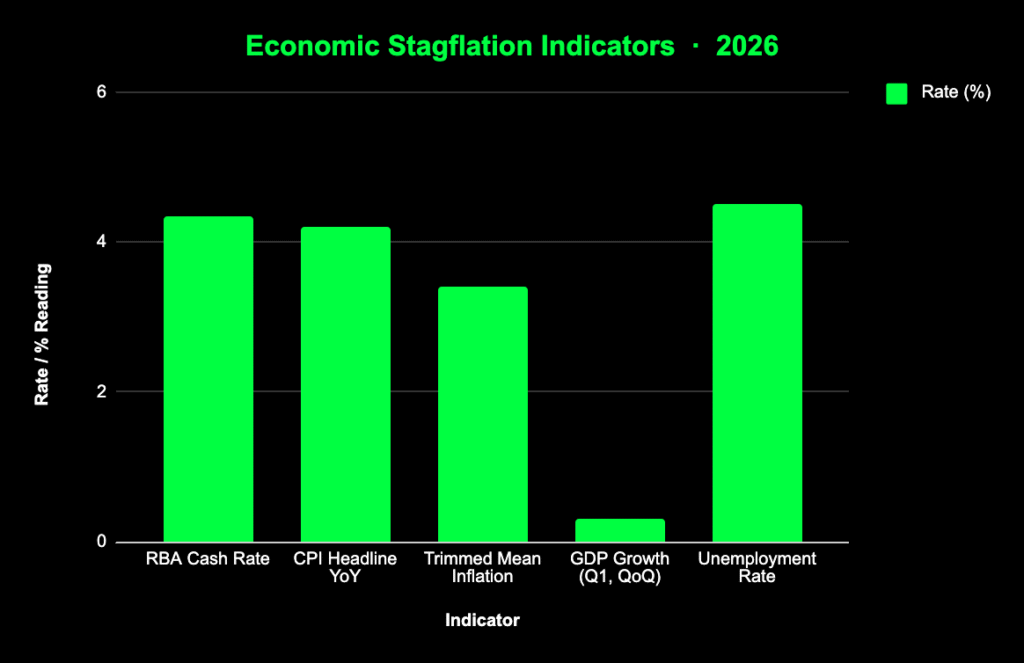
Data sourced from Australian Bureau of Statistics, 2026
The RBA raised its cash rate to 4.35% on 6 May 2026, its third consecutive hike this year (Canstar, 2026). ANZ and CBA see this as the peak; NAB forecasts a further hike to 4.60% in August; Westpac projects two more, taking it to 4.85%. Even the most optimistic scenario has rates elevated well into 2026, and with underlying inflation projected above 3% until late 2027, cuts before 2028 are increasingly unlikely (Reserve Bank of Australia, 2026).
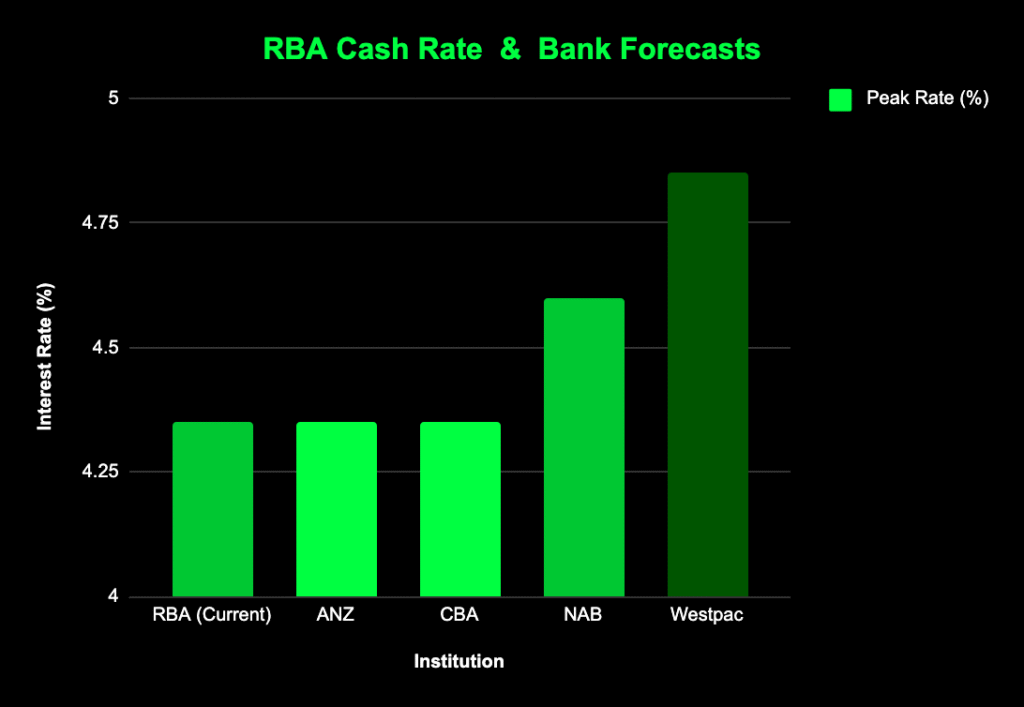
Data sourced from Canstar, 2026
Where does that leave investors?
Rotating wholesale into growth is like a viable strategy in markets like the US, but this is not so relevant for the ASX. This is because technology stocks account for roughly 30% of the S&P 500, whereas financials (28.3%) and materials (18.2%) together represent nearly half the ASX (StockMetric, 2026; DiscoveryAlert, 2026). The more productive move is to rotate within value: away from the bank-heavy trade and toward the parts of the value universe that stagflation actually supports.
Data sourced from StockMetric, 2026
Resources stocks are largely indifferent to domestic rate settings, driven instead by global commodity prices. Geopolitical tensions have pushed energy prices higher, directly benefiting Australian oil and gas companies. Gold miners are also well positioned, with inflation driving demand for gold, a weaker Aussie dollar means that miners receive more local currency per gram.As of early June 2026, Northern Star Resources (ASX: NST) was trading at 52-week highs even as broader equity markets fell (Trading Economics, 2026).
Infrastructure offers a different kind of shelter. Transurban’s (ASX: TCL) toll revenues are contractually linked to inflation, meaning the same price pressures hurting borrowers are directly lifting its income.
Consumer staples like Coles and Wesfarmers benefit from a separate dynamic. When households are stretched, spending shifts from restaurants and discretionary retail toward supermarkets and discount retailers.
Franking credits remain a structural advantage across all three sectors. A fully franked dividend is worth considerably more than its face value once the attached tax credit is factored in, particularly for SMSFs in the pension phase, where excess credits are refunded in cash.
The takeaway
This is a value market, but not the value market most ASX investors are running. The bank-heavy, fully franked dividend trade that has defined Australian value investing for a generation is under specific pressure from stagflation. Rising arrears, negative gearing headwinds, and a management class slowly building provisions all point to the same conclusion: CBA’s crash is a systemic response to what sustained higher rates do to Australian household balance sheets, and the same conditions sit on every major bank’s loan book.
The better positioning is in resources, infrastructure and defensive consumer staples as they are businesses whose earnings are either indifferent to the domestic rate cycle or actively supported by the inflationary conditions driving it. Growth earns a place in the portfolio only if it is light on capital, carries contracted recurring revenue, and has no meaningful reliance on cheap debt.
Disclaimer
Vitti Capital Pty Ltd (ABN 13 670 030 145) is a Corporate Authorised Representative (001306367) of Point Capital Group Pty Ltd (ABN 41 625 931 900), the holder of Australian Financial Services Licence number 518031. This communication contains general information only and does not take into account your objectives, financial situation, or needs.
Before acting on any information, you should consider whether it is appropriate to your circumstances. We recommend you seek personal financial advice before making any investment decision.
If you have not previously received a copy of our Financial Services Guide (FSG), it is available free of charge by contacting us or via https://vitti.capital/fsg/
Past returns do not always indicate future returns and there is always a risk of loss when trading and investing. Our Privacy Policy is available at https://vitti.capital/privacy-policy-2
